
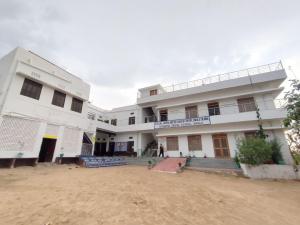
By Abani N A
Growing up in a small village of Kerala, confined to the comforts of my life, I never realized that access to quality education is a myth for many children until I reached a small village in Rajasthan called Singla. During my internship in Tilonia, Rajasthan, I had the opportunity to work on the impact assessment of a Residential Bridge School located in Singla. Run by Barefoot College, this school was started in 2013 to support children who had dropped out of formal schooling. The idea was simple but powerful: offer a 10-month program to help students catch up to a 5th-grade level and rejoin mainstream schools. This opportunity to be embedded in a community and work closely with children lit a spark in me convincing me to become a part of the education sector in India. I then joined Teach For India and today I am working as a teacher in a low-income school in the vibrant cultural and commercial heart of Gujarat.
While I was searching for internships, one of my professors passionately spoke about Barefoot College; his enthusiasm stuck with me and that’s what inspired me to apply. Before I knew it, I was on my way to a small, remote village called Tilonia in Ajmer district of Rajasthan. The journey there felt surreal and a little intimidating. The road seemed to stretch endlessly into the unknown, and the further we went, the more isolated it felt. I wasn’t alone, though. I was traveling with my friend and her mom, Mousumi aunty. I still remember her anxious voice as she looked out the window and muttered, half-joking, half-serious, “Where in the world am I leaving my girls… in the middle of a forest?” We all laughed nervously, but deep down, I shared that same mix of fear and excitement.
We finally reached Tilonia and got settled in. It took a few days to adjust, to slow down, really. Life at Barefoot College was simple, almost minimalistic, with just the basic facilities. We had everything we needed to survive, but the shift was still tough. From a bustling, touristy city to a quiet, secluded village felt like stepping into another world. But soon, the village started to feel less distant and more like a place with a heartbeat of its own, thanks to the people we met. Everyone had a story to tell, and every story revealed a new layer of Barefoot College that we hadn’t seen online.
There was Ramnivasji, who, in his twenties, cycled 45 kilometers just to reach Barefoot. Now in his 60s or maybe even 70s, he’s still there, still working with the same spirit. Then there was the Barefoot Dentist, an illiterate woman trained by the organization, who once got the ride of her life when an Australian pilot, grateful that she cured his toothache, took her up in his helicopter. Magan Kanwar, despite having studied only up to the third grade, she has become a skilled solar engineer and an inspiring trainer. Her passion and determination have taken her across the world, to places like Tanzania, Senegal, and Bhutan, where she shares her knowledge and empowers others through her work. Each person I met made Barefoot come alive for me.
What really caught my attention was how Barefoot approached education. Once I shared my interest, I got the chance to work closely in that area and I was more than happy to explore the diverse educational initiatives by Barefoot College. The organization runs different types of schools, each designed according to the specific needs of children. They have night schools, Siksha Niketan and a Residential Bridge School. I worked on the impact assessment of the Residential Bridge School, but I want to share my beautiful and memorable experience in all the schools I visited. Let’s start with Siksha Niketan.
Siksha Niketan
Siksha Niketan is meant for the children of migrant workers. Since their parents often move from one place to another for work, these children’s education gets disrupted, and many of them end up dropping out of school. Siksha Niketan offers them a stable place to stay and continue learning. My most memorable and fun time in Siksha Niketan was during the student parliament. This weekly parliament gathering is a democratic setup where students from each class elect a minister and each minister will have a portfolio to manage. There was an education minister, cleanliness minister, discipline minister etc.
Every Sunday, the student parliament gathers together. The ministers take their seats on the elevated platform, while the rest of the students settle down on the tiled ground. Education coordinator Yogita was there as a facilitator. The meeting always begins with a peaceful prayer, setting the tone for the day. Then, one by one, our student ministers take the stage to share updates about their roles and responsibilities.
The Education Minister’s duty is to check if students have all their supplies, pencils, pens, books and whether they’re taking care of them. The minister pointed out a few friends who need to be more careful with their books or focus better during study time. Once the minister is done speaking, the audience can raise their complaints and concerns. After the Education Minister wrapped up, it was time for the Cleanliness Minister and things got hilarious real quick! With a dramatic sigh, the minister revealed that one student hadn’t taken a bath in 15 days! Fifteen! But hey, to be fair… it was winter. We totally get it. Then came the audience’s turn to speak and they didn’t hold back either! Someone accused the minister of not bringing them toothpaste. And when Yogita asked, “Okay, be honest, who didn’t brush today?” every single hand shot up. Even the ministers! Anyway, I find this Student Parliament truly fascinating. It gives students a real feel for how a democratic system works, and it’s an amazing way to nurture leadership skills and bring future leaders to the forefront. Devaki, one of the student prime ministers, got invited to Sweden to receive the World’s Children’s Prize. She even had a chat with the Queen! How cool is that?
Night School
Barefoot runs various night schools at different locations. I’m glad that I visited a few of the night schools with Rameshwarji, the coordinator. We went to the night schools at Dadiya, Roopangarh and Padampura. All these places are in remote areas, far from even the nearest small towns or cities. Night schools are for children who can’t attend regular school. Most of them spend their day time working, grazing cattle, helping their parents in the fields, or doing household chores. And yet, after a long day, they still show up to night school full of energy and eagerness to learn.
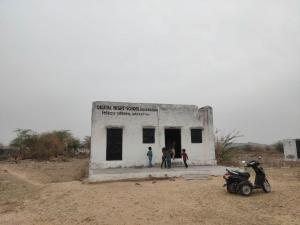
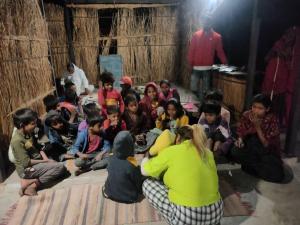
Each village had its own unique story. Dadiya is home to families from Scheduled Castes and Scheduled Tribes. In Padampura, the children come from communities often labeled as outcasts. The journey to Padampura is unforgettable, I literally thought we were moving through a desert. And in Roopangarh, I met kids from diverse groups like the Banjara, Rao, and Bhopa communities. Despite the challenges they face, these children show incredible spirit.
Residential Bridge School: Bridging Dropouts to Dreams
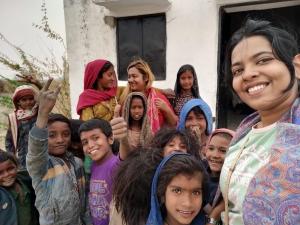
The bridge school is located in the small beautiful village of Singla. Getting to Singla from Tilonia is quite a long journey. Finding transport in Tilonia isn’t easy either, so we usually have to rely on the vehicle section at Barefoot to arrange a ride. The school is located in a beautiful setting, facing vast fields with clear blue skies and lots of peacocks wandering around.
The school itself runs a unique ten-month program. In that short span, students work their way up to a 5th-grade level of education. Each batch admits around a hundred children, most of whom have dropped out of school at some point in their lives. Before enrollment, surveys are carried out across several villages to identify these children, those who’ve had to pause their education for reasons beyond their control.
Many of these children had left school due to poverty, family responsibilities, or a general lack of interest. Most students belonged to marginalized communities, primarily OBCs, followed by SCs and STs. The bridge school has given hundreds of such children a second chance at learning.
I wanted to gain a deeper understanding as to why so many children had dropped out of school in the first place. So one day, I decided to visit a nearby government school, just a five-minute walk from the Bridge School. I was hoping to find some answers there, but the staff weren’t very forthcoming, and I left feeling unsatisfied. Thankfully, with the help of Mohanji, who is like an overall coordinator at the Bridge School, I got an opportunity to speak with a few of the parents directly. Since I don’t speak Hindi and can only understand a little bit, I brought along a friend to help me out.
But as it turns out, the parents didn’t speak Hindi either, they spoke Marwari! That’s India for you, so many languages, cultures, and layers of diversity. It’s absolutely amazing. The whole conversation turned into this wild and wonderful game of translation. I’d ask a question in English, my friend would translate it into Hindi for Mohanji, who would then switch it to Marwari for the parents. Their responses would travel all the way back the same way, Marwari to Hindi to English. It was like a relay race of languages, and honestly, it was hilarious and kind of amazing at the same time. This hard work was worth it though. I got my answers.
I interviewed several parents to understand why their children dropped out of school in the first place. A common reason was lack of interest. Many children were enrolled in the nearby government school, but attendance was irregular. Some would leave in the middle of the day, claiming to go to the washroom, and simply not return. The bridge school was only five minutes away from the government school, yet its very existence showed how high the dropout rate was.
Through conversations with teachers, I came to understand that caste dynamics also play a big role. Singla village is largely inhabited by Rajputs, who are upper caste and financially better off. They usually send their children to a private school located 18 kilometers away. Meanwhile, the government school is attended mostly by children from Scheduled Castes. With no public transportation in the village, only families who own vehicles can afford to send their children to the distant private school. This creates a clear divide in educational access and deepens caste-based segregation.
Such separation reduces opportunities for children to interact across caste lines. It reinforces stereotypes, limits empathy, and weakens the social fabric. Even for those who do complete school, the lack of nearby colleges, some are 80 km away, makes higher education nearly impossible. As a result, many fall back into the same patterns of economic and social struggle.
Sharoni, Pooja’s grandma was one of the people we interviewed. She beamed with pride when she talked about her granddaughter. She remembered the days when Pooja used to go to the government school, completely disinterested in her studies. “She would say she is going to the washroom and then just disappear from the school,” she recalled with a chuckle. But things had changed. Pooja was truly learning, and it showed. Sharoni added with joy, “Pooja could even manage small accounts now. She went to the market, bought things on her own, knew exactly how much change she should get, and she could read too!” Now that’s impressive. Barefoot showed me that even in the most remote corners of the country, meaningful change is possible when learning is rooted in community, care, and creativity.
I had more questions. What do they do after completing the 10 month schooling in the Bridge school? The reality is quite sad. From the conversations with the Math teacher in the Bridge school, I got to know that not all students were able to continue their studies after leaving school. Even if they finish school, going to college is very difficult. There’s no public transport in these villages, and the nearest college from Singla is about 80 kilometers away. For many, higher education is something they just can’t afford or access. But the Bridge School is a powerful first step, a creative and meaningful way to bring education to marginalized communities. After their time here, every student becomes literate and learns basic math, which makes a real difference in their everyday lives. It’s amazing to see how even this small beginning can open up new possibilities for them.
Conclusion
Every school I visited, every child I spoke to, and each dusty road I walked down left a mark on me. Some moments made me smile, others made me think deeply, but all of them reminded me how learning takes so many shapes. It’s not just about schools or classrooms; it’s about people, stories, laughter, and resilience. I went there to understand education, but in the process, I ended up learning a lot myself. I continue to explore how deeply the education system is tied to people’s lives, especially for those pushed to the margins. The more I see, the more I want to understand. This journey is far from over.
Bio:
Abani N A, currently a Teach for India fellow, working as a teacher in a low-income private school in Ahmedabad, Gujarat. She completed her Masters in Human Rights and Inclusive Policy from Pondicherry University.
***
Like Cafe Dissensus on Facebook. Follow Cafe Dissensus on Twitter. Follow Cafe Dissensus on Instagram.
Cafe Dissensus Everyday is the blog of Cafe Dissensus magazine, born in New York City and currently based in India. All materials on the site are protected under Creative Commons License.
 Cafe Dissensus Everyday