
By Rajorshi Patranabis
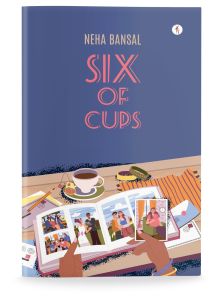
Neha Bansal’s collection of poems, Six of Cups, published by Hawakal Publishers, is a book of myriad nostalgia delving into the depths of mostly forgotten human emotions. Woven in different and contrasting colours, the title of the book, as well as the cover, can be misleading to say the least. Six of Cups, the title, can be very well read as something to do with the Tarot scheme of things. The cover by Bitan Chakraborty confuses one even more. A blue cover displaying an album with photographs akin to Tarot cards. The compulsive Wiccan in me forced a belief that this must be a book of Tarot poetry. Intrigued, I delved inside. The cover is the mind of the book – determined, arrogant yet fickle and confused.
Neha Bansal is a top-notch bureaucrat posted presently in Delhi. I was personally very intrigued with her when I met her for the first time at the World Book Fair, New Delhi. She was extremely unassuming. In fact, she looked just like me and others around with an immense passion for books. My very idea of an IAS officer, who should mandatorily have some extra ‘air’ around her, came crashing down and broke itself to pieces. My publisher, Dr Kiriti Sengupta, introduced me to her: “She’s Neha Bansal. She’s an IAS.” Almost unwittingly, with disbelief, I looked at her and said, “What?” and an embarrassed Neha looked at me and said, “Yes sir, I am into administrative services. Sir, I have read your book.” Now, more than being ecstatic, I was doubly embarrassed. A simple young woman, an IAS officer, who had read me. I had no place to hide. I reminisced about this meeting, our interactions and my notions about Neha while reading this collection.
This book is like an old album with torn and at times faded photographs, black and white, sepia and occasionally a coloured frame looks out. It smells musty, wet and again at times fresh like a bunch of lavender. The dynamics of the poems moving from Car Nicobar to Chandigarh, from laddus to Kadhi Chawal forms the body of this collection of a nostalgic treat.
and the savoury rock salt and
the sharpness of red chili
combined curiously
to add colours to the
toasty winter afternoons. (“The Black Carrot Kanji”)
Bansal’s poetry has a distinct way of transporting the readers to the past, not just by her words but by her very vivid imagery. Her way of composing the verses can make one actually go through the experience. The previously quoted lines can very well catalyse the taste buds in some – well, it did to me.
Another very pertinent emotion that she has tapped into is the family bonds that are slowly vanishing in this age of nuclear homes. This very aspect of this book forms the soul of her collection:
In short, convinced fully
that she was indeed the
very bane of my life
how I prayed that she
gets married soon.
Why then, did I cry
like a baby, clutching
her left-over clothes,
the day after her wedding. (“Sibling Squabbles”)
A poem that caught my attention is titled “Wishful Thinking” in which she talks of her Baba:
Also did you know that
a single eyelash often
sticking to the cheek
if blown away gently
while meditating on our
deepest desires,
can build a rainbow
to teleport us to
the very heaven of fulfilment.
I hate explaining my understanding of any particular poem, but this one is deeply spiritual, as far as my understanding goes.
A very important point that needs mention here is the lucidity of Neha’s language and her extreme capacity to speak of deep emotions in a simple way. This simplicity is not easy to achieve, and this very aspect will attract those readers who find poetry and poets belonging to a different milky way.
The only thing that had affected me personally is the overwhelming number of footnotes in this book. I do understand the nuances of her language as I am habituated with the parlance of North India. I stress on this as I feel that every poem has its unique tune and rhythm, and the footnotes unsettled them at times.
A huge shout out to Hawakal Publishers for taking up this very interesting and unique project. This book lights up the darkness that we’ve left behind and forgotten.
Bio:
Rajorshi Patranabis is a multilingual poet, editor, translator and reviewer dabbling in different forms of poetry. A Wiccan by philosophy, he has ten collections of poetry (nine in English and one in Bengali) and four collections of translations including two co-authored with Dr. Ranjit Dutta of Assam.
***
Like Cafe Dissensus on Facebook. Follow Cafe Dissensus on Twitter. Follow Cafe Dissensus on Instagram.
Cafe Dissensus Everyday is the blog of Cafe Dissensus magazine, born in New York City and currently based in India. All materials on the site are protected under Creative Commons License.
***
Read the latest issue of Cafe Dissensus Magazine, “Epidermal Metaphors and Narratives in India”, edited by Elwin Susan John, Sophia College, Mumbai, India.
 Cafe Dissensus Everyday