
By Shahid Jamal
No incident happens in our society unless we allow it to happen. We may deny it a thousand times, but we are involved in every good or bad incident that occurs in our surroundings. Sometimes, as members of society, we actively engage in it, and most of the time, we are passively involved by becoming mute spectators. Many of us believe that since we are not directly and actively engaging in the crime, we are not accountable for anything. However, there is no escape from moral accountability in such situations, as W.S. Burroughs rightly points out, “There are no innocent bystanders. What are they doing there in the first place?”
It is a fact, though it may be uncomfortable to hear, that many of us enjoy violence. We enjoy violence from the cinema screen to the city street. We are indifferent to violence until it affects us, but we oppose it the moment it does. Violence has many forms and manifestations, but an important aspect that we generally do not discuss, though it should be discussed, is that women are central to most forms of violence, often as the primary victims.
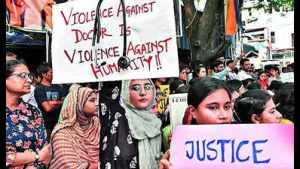
What happened in R. G. Kar College in Kolkata has also happened before. Rather, it happens every day and reported in daily newspapers on frequent basis but only in few cases, we have reacted in such anger and staged long sustained protests across India. We are very selective in terms of raising our voices against any crime in general and crime against women in particular. To understand the nature and forms of crime against women and the selective outrage against it, it is imperative to examine it in the larger social context.
Crimes against women are a pervasive issue with deep historical roots. Throughout history, women have been subjected to various forms of violence, including dowry-related abuse, rape, murder, honour killings, and other gender-based atrocities. In an article, “Women and Violence”, published in Economic and political Weekly, Nandita Haksar writes “women have been victims of special kinds of violence, whether it is foot binding in China, clitoridectomy in Sudan or sati in India.” In contemporary society, the lack of safety for women is pervasive and alarming. Women face threats in every sphere of life—at home, in educational institutions, at work, on the streets, and even before birth, within the womb.
The increasing incidence of crimes against women can be traced back to historically entrenched power structures. The root of this violence lies in the structured power dynamics between men and women, which are deeply embedded in Indian society and reinforce patriarchy. Patriarchy operates within this power structure, legitimizing male dominance and assigning distinct roles to men and women. It dictates different patterns of socialization for males and females from a young age. To eliminate crimes against women, it is essential to challenge these existing power structures. It is crucial to address gender power dynamics, starting within the fundamental social unit of the family.
We all know that women are not a homogenous group. They can be identified in distinct groups based on religion, caste, class and ethnicity. Though women in general are subject to the violence but women belonging to the minority religious groups, lower caste groups, low-income groups and tribal groups are specifically more vulnerable. When crime against women belonging to these groups are reported, we generally do not pay any heed to it. We are insensitive and indifferent towards these groups. There are plenty of examples available to corroborate my argument. As far as our selective outrage is concerned generally it comes out to fore only when the victim is not from these groups. In the R. G. Kar medical college case, the victim was a doctor, an upper-caste individual in a high-paying, presumably dignified profession. Therefore, the entire medical fraternity mounted pressure upon the government to act against the culprit. It staged protests across India and expected everybody to participate in it. People across spectrum participated in the protest. The medical fraternity also staged a nationwide strike, escalating the protest. Yet, this same medical fraternity was largely silent when women from various segments of society experienced sexual violence. Despite victims being brought to hospitals for medical examinations or post-mortems in every such incident, how often do we see doctors calling on the government to address the increasing crimes against women?
Even as protests continue across India, another similar incidence happened in Muzaffarpur, Bihar where a 14-year-old Dalit girl was abducted, gang-raped, and murdered. Her mutilated body was found near a pond. This incident occurred just three days after the R.G. Kar medical college incident, but the media coverage and public outrage seen in the former are missing in the latter, likely due to the victim’s marginalized social status as a Dalit. In our country, Dalits are subjected to untouchability, with upper-caste individuals avoiding even their shadows to preserve their so-called purity, yet paradoxically, raping a Dalit woman does not taint that purity. It is unfortunate that the systemic violence faced by Dalit women in India is not adequately addressed. Our biases are so deeply ingrained that we have normalized crimes against Dalit, Adivasi, and Muslim women to the extent that these atrocities no longer shock or disturb us. As a society, we have deteriorated to the point where even convicted rapists are honoured and garlanded simply because their victims were Muslim. This stark reality reveals just how thoroughly bigotry has infiltrated the collective mindset, compromising our basic sense of justice and humanity.
In a country where a young girl is brutally raped and murdered, and people take to the streets waving the national flag in support of the rapist simply because the victim was Muslim, it becomes starkly evident how profound the vulnerability of Muslim women is and the forces driving it. Similarly, when tribal women are raped within police stations, it exposes how the state apparatus not only sustains but institutionalizes a culture of rape. Our selective approach and biased mindset prevent us from raising our voices against any form of violence in general, and violence against people from vulnerable sections of society in particular, However, it is essential that we, as a society, recognize that violence is violence, irrespective of the victim’s identity, and unequivocally condemn it in all its forms.
In recent years, a new dimension has been added to how crimes against women are perceived and the selective outrage they receive: the political dimension. In India, political parties often exploit such incidents for electoral gains. For instance, the BJP, which organized widespread protests in response to the recent Kolkata rape case, chose to remain silent when a girl was paraded naked in Manipur, where the party was in power. This issue is not confined to the BJP; the TMC displays similar patterns. While TMC leaders vociferously condemned the Manipur rape case, their response has been muted when similar incidents occur in their own state. Ironically, instead of ensuring that perpetrators face the harshest penalties, West Bengal Chief Minister Mamata Banerjee has been leading rallies as a form of protest. Despite being in power, she acts as though she were in the opposition. This raises the question: who is she actually protesting against? Her own government? Her approach not only exposes her inability to act effectively but also highlights her failure to address the issue with the seriousness it requires. The blame game has long been a fixture in politics, but it is disheartening to see it extend to heinous crimes against women. Political parties are now competing to outdo each other in moral bankruptcy, while citizens have been relegated to mere spectators, passively cheering from the sidelines.
The Times of India report, published on April 3, 2024, highlights a significant increase in crimes against women in India, with the National Crime Records Bureau (NCRB) recording over 4.4 lakh cases in 2022, which equates to an average of 51 cases per hour. Uttar Pradesh, with 65,743 FIRs, reported the highest number of registered cases of crime against women in the country. It is important to note that these are reported crimes against women; many crimes are generally not reported, and if these unreported cases were included, the number would be even higher. A senior criminal lawyer, Rebecca M. John, who has represented many rape victims, said in an interview with Reuters, “Some offenders still believe they can get away with their crimes, and the significant factor is the lack of fear of legal repercussions.”
It is high time to examine the role of the state in addressing reported crimes against women. The recent crimes against women and how the state has dealt with the perpetrators of these crimes is not only enough to prove its stance on women’s safety but also clearly exposes its role in perpetuating them. People are well aware of the crimes that have occurred recently, so I need not mention them individually. In most cases of violence against women, it has been observed that the state apparatus, using all tricks in its bag, tries to protect the culprits while victims suffer a double brunt – first from the rapist, and then from police harassment when they go to register an FIR. Disturbingly, there are instances where victims seeking justice have encountered additional abuses from law enforcement. For instance, on May 6, 2023, The Hindu reported a case from Lalitpur, Uttar Pradesh, where a 13-year-old girl alleged that she was raped by a police station in-charge after she had gone there to register a complaint about a gang rape case.
Imagine the outrage if our Prime Minister were to campaign for a mass rapist, actively urging the public to vote for him as an MP. Yet, this troubling scenario is not as far-fetched as it might seem. Despite videos surfacing that show the individual Prime Minister Modi supported in highly compromising situations, he has remained eerily silent and has failed to issue a public apology for endorsing someone with such a grievous record. This glaring omission exposes a deeply troubling disregard for women’s safety and justice.
Modi’s approach to sensitive issues has been marked by a troubling pattern of selective engagement. For instance, while he was quick to extend heartfelt congratulations to an Olympic medallist, he has been conspicuously silent regarding the year-long protests at Jantar Mantar led by Olympic wrestlers Vinesh Phogat, Bajrang Punia, and Sakshi Malik. These athletes have been bravely standing up against the Wrestling Federation of India and its former chief, Brij Bhushan Sharan Singh, in response to serious allegations of sexual harassment.
The contrast between Modi’s swift public acknowledgment of sports achievements and his silence on issues of sexual harassment and systemic abuse is stark. It reveals a strategic media management approach that seems more concerned with political optics than with addressing pressing issues of justice and safety. This pattern of selective response – vocal when politically convenient and mute when inconvenient – raises serious questions about the seriousness of the Prime Minister’s commitment to women’s rights and his genuine concern for justice.
The Prime Minister of our country is not the only one who appears indifferent to women’s safety. Even the President, one of the most powerful women in India, seems so powerless that she didn’t address the critical issue of women’s safety in her Independence Day speech. While the nation expected her to speak out against the rising crimes against women, she instead chose to highlight the government’s achievements in women’s empowerment. After reading her speech, I am left puzzled as to how a woman, especially one holding such a powerful position, can be so detached from the concerns of her own gender. She says,
In our society, women are considered not only equal, but even more than equal. However, they have also suffered from traditional prejudices. But I am glad to note that the Government has given equal importance to women’s welfare and women’s empowerment. The budget allocation for this purpose has more than tripled in the last decade. Their participation in the labour force has increased. The most heartening development on this front has been the significant improvement in the sex ratio at birth. A variety of special government schemes have also been designed keeping the women at the centre. Nari Shakti Vandan Adhiniyam is aimed at ensuring real empowerment of women.
In contrast to the speech delivered by Murmu on the eve of Independence Day recently, which aligns more closely with the government’s narrative rather than addressing the persistent dangers and injustices women continue to face, exactly 24 years ago in 2000, President K.R. Narayanan delivered a powerful speech that directly addressed the grim realities faced by women in India even today. He states,
Our women are still treated as less than human. Day in and day out, we read in the newspaper’s gruesome stories of dowry deaths of young women in the flower of their youth, because of the insatiable greed of husbands and the in-laws. The law enforcing agencies remain indifferent or ineffective, and the law itself remains awfully inadequate. In fact, statistics show that crimes against women have been on the increase. No place is safe for them, not even their own homes. Swami Vivekananda used to say, ‘the land of India is soaked with the tears of widows’. Today, it is soaked by the tears of women in general, and even girl children, who are ill-treated and murdered. Dark clouds of doubts are hovering all around, the benefit of which is to be given to the accused. Indeed, there are dark clouds of prejudice and callous unconcern hanging over our society with regard to the problem of rape and atrocities on women.
One might question why I am comparing the former president K. R. Narayanan’s speech with President Murmu’s recent speech delivered by her on the eve of 14 August. The purpose is to highlight the evolution of democracy in India and how the narrative around women’s issues has changed. This also supports my argument that having a woman as president doesn’t necessarily protect women’s rights, just as having a Dalit or Muslim president doesn’t necessarily ensure the rights of Dalits, Scheduled Castes, or Muslims. K.R. Narayanan’s speech serves as a crucial reminder of the ongoing need for governmental accountability and effective action with respect to women’s safety.
On 28 August, President Murmu finally broke her silence on the RG Kar Medical College rape case, but it took her two weeks to react. The delay may have been due to concerns about the message her response might send if she commented only on this rape case while remaining silent on past incidents. It is evident that her reaction now seems selective. When she expressed dismay and horror over the Kolkata rape case, people from various quarters, including the opposition, questioned whether she felt the same about the parading of a naked woman in Manipur or the incidents in Kathua and Unnao. Ironically, the good thing about our democracy is that the President is not obligated to respond, and this goes in favour of President Murmu too.
How can we ensure women’s safety and achieve gender justice in a country where outrage over crimes against women seems selective, from ordinary citizens to the highest offices? When will we understand that our outrage against violence, especially against vulnerable segments of society, should not be influenced by our biases or prejudices? It is crucial that we recognize our collective responsibility to address crimes against women, regardless of who the perpetrators are or what identity they hold. In contemporary society, we are interconnected; if any individual, community, or group faces vulnerability or violence, it ultimately affects us all.
Recently, we marked our 78th Independence Day. Mahatma Gandhi once said, “India will be free when women feel safe walking the streets of India at midnight.” This statement highlights that the actual freedom is measured by the safety and respect women receive. Despite the progress we have made so far, achieving this vision remains a significant challenge.
Bio:
Shahid Jamal is a Senior Research Fellow, Department of Educational Studies, Faculty of Education, Jamia Millia Islamia, New Delhi. Email: shahidjamaljmi@gmail.com. On X: @ShahidDarwish
***
Like Cafe Dissensus on Facebook. Follow Cafe Dissensus on Twitter. Follow Cafe Dissensus on Instagram.
Cafe Dissensus Everyday is the blog of Cafe Dissensus magazine, born in New York City and currently based in India. All materials on the site are protected under Creative Commons License.
***
Read the latest issue of Cafe Dissensus Magazine, “Epidermal Metaphors and Narratives in India”, edited by Elwin Susan John, Sophia College, Mumbai, India.
 Cafe Dissensus Everyday