
By Rimli Bhattacharya
A couple of months ago, I was diagnosed with a new mental illness. My psychiatrist spelt it as Borderline Personality Disorder. I would get panic attacks, would cry helplessly for hours together, sometimes even days. Writing is my hobby, but I would be scared like a kitten whenever I looked at my laptop. My pills increased; my daughter would console me, but nothing would calm me down. The once me who loved watching movies on the OTT platforms dreaded it then. My counselor always said that the right things come to the right people at the right time. May be, I was destined for the right occasion which would somewhat ease my illness. My job called me to relocate to Ahmedabad (an extremely warm city) and I loathed myself working long hours for a company which would pay me a handful at the end of the month. My illness will now get better, I thought. On the contrary, it worsened. The climate did not suit me, and I grew mentally as well as physically ill. I quit my high paying job. But I was still unhappy as I could not write a word. To add to the misery, my colleagues tried to connect with me on social media to start a clandestine affair. After all I am a single mother and a helpless woman in a new city.
I read somewhere that unhealed trauma prevents one from getting close to someone again. I couldn’t return any pleasantries my colleagues exchanged. Not that I liked them and was desperately looking for love. All I needed was a little empathy which I didn’t find in them. In return, my daughter suffered. She saw her mother cringe, suffer repeated anxiety attacks, visit temples, churches, mosques et al. every single day.
And then I watched a film that changed things for me.
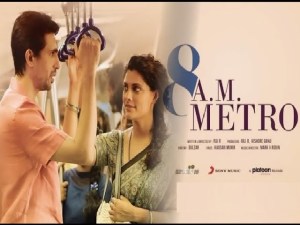
I was eager to watch this much underrated movie 8 A.M. Metro (1923), directed by Raj Rachakonda. Starring Gulshan Devaiah as Preetam and Saiyami Kher as Irawati, the movie deals with mental illness very subtly. The movie is based on Malladi Venkata Krishna Murthy’s book, Andamina Jeevitam.
Irawati is a bored Maharashtrian housewife and Preetam, a banker, meet accidentally in a metro and their lives change forever. We tend to judge the friendship of a man and woman and try to fit them in the mould of a lover. Even I thought so. But how wrong I was.
Irawati suffered a trauma in her childhood and dreaded travelling in train until she had to manage the journey alone when her husband refused to accompany her all the way to Hyderabad from Nanded to tend to her sister dealing with a complicated pregnancy. During her first journey in the metro, Irawati gets a panic attack and is approached and calmed down by Preetam.
A friendship blossoms between the two. Irawati opens up to Preetam about her trauma, anxiety and panic attacks. In one of the scenes, Preetam and Irawati play the roles of Irawati and Society, where our parochial mentality compels Irawati to stay “strong” despite knowing that she has a case of unhealed trauma and suffers from consternation and hysteria. Visiting a psychiatrist looks like a distant possibility. Preetam who accompanies Irawati on her journey in the 8 A.M. Metro is a victim of depression but the two develop a bond so pure that they both come out of their individual lacerations. Relationship between a man and a woman need not necessarily be that of a brother and sister, husband and wife, and, last but not the least, lovers.
The movie is prosaic. At times Irawati and Preetam sip filter coffee over poetry. Gulshan Devaiah and Saiyami Kher deliver stellar performances. The movie enabled me to understand myself, my illness and in dealing with advances of men. Mental illness is common, and we need to be vocal about it rather than pushing it under the carpet. Also, a married woman can be friends with a married man. There is nothing wrong in it.
In this context, I would like to share one of Gulzar’s poems, “Son Machharee”:
jo ‘son machharee’ ka badan lekar
doobee rahatee is jheel kee tah mein
tum chaand kee tarah aate
is jheel ke paani par
aur raushnee kar dete
andhere mere ghar mein.
tum tairate aur kahate:
is jheel kee tanhaee…
aur kaash koi hota
jo pyaar tumhen karta!
main aatee kinaare tak,
aur dostee kar letee…
‘son machharee’ tumhaaree!
tanhaee ko bhar detee
aur tumako sukoon milta
tum sochte:
kaash is jheel mein ‘son machharee’ raha kartee!
There is a saying that that right things come to the right person at the right time. This movie proved a blessing in disguise for me. It was indeed the right occasion for me. Watch it and you may discover yourself in a completely new avatar.
Bio:
Rimli Bhattacharya is a first class gold medalist in Mechanical Engineering with a MBA in supply chain management. She has contributed to two anthologies, A Book of light and Muffled Moans and has written two solo books, The crosshairs of life and That day it rained and other stories. Her other works have appeared in twenty-nine literary magazines & E-Zines. She is also an Indian Classical dancer.
***
Like Cafe Dissensus on Facebook. Follow Cafe Dissensus on Twitter. Follow Cafe Dissensus on Instagram.
Cafe Dissensus Everyday is the blog of Cafe Dissensus magazine, born in New York City and currently based in India. All materials on the site are protected under Creative Commons License.
Read the latest issue of Cafe Dissensus Magazine, “Epidermal Metaphors and Narratives in India”, edited by Elwin Susan John, Sophia College, Mumbai, India.
 Cafe Dissensus Everyday