
By Rakhi Dalal
Gently flows the river to the sea / carrying stories of infinite memories…
“Reaching Out”, Flight of the Angsana Oriole
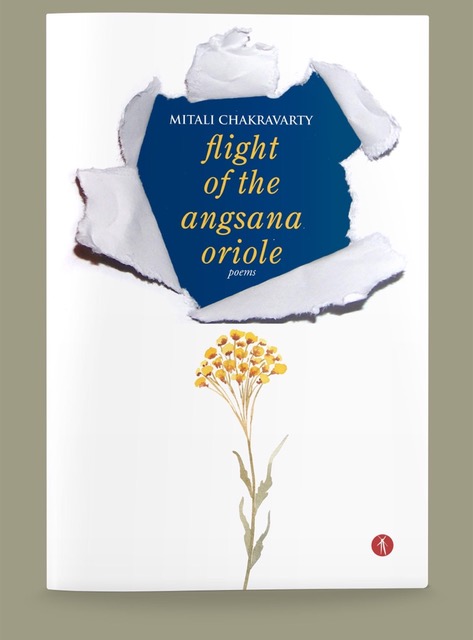
Human life is a journey from unknown to unknown. In between we live in pursuit. Love, reason, family, relationships or just making sense of the living. This transit is marked by the memories we create. Remembrances become stories that we carry and which in turn carry us. The poems in Mitali Chakravarty’s Flight of the Angsana Oriole, published by Hawakal Publishers Private Limited, are such memories – stories of hope, wonder, love, despair, loss, grief and reflection. The poet meditates upon not only the questions that torment us but also upon the answers that bring sanguine belief in the generosity of human spirit. She reflects upon the despair of human condition in troubled times, agonizes over the pain that is the price of each strife, each war, while never letting her belief diminish in the human ability to ricochet from trials and tribulations of such times. Her poetry reverberates with the ache of loss while dancing on the potions of love.
Flight of the Angsana Oriole is a collection of 72 poems. Mitali Chakravarty is a writer and poet who believes in a world without borders. In her quest of harmony, to let the words travel across the world without constraints, to stimulate exchange of ideas unreservedly, she founded Borderless Journal, an online forum that features writers from all over the world. The Journal published its first Anthology Monalisa No Longer Smiles: An Anthology of Writings from Across the World (Om Books International) last year. She has a book of essays on living in China, In the Land of Dragons and has been part of numerous anthologies and journals.
The poems in this collection aren’t strictly divided into sections and yet a structure seems to emerge as one progresses from one poem to the next. Some poems are a calling to Mother Nature – to the wonders that it has bestowed upon us humans while we continue to ravage it, whereas some poems are longings to be one with her – in any form that contributes to the unanimity in the scheme of Universe, a balance that can assure a peaceful and just future for this little planet we call home.
The poet voices the innate human desire to connect with nature. She is so mesmerized by its beauty and its song that she finds it difficult to differentiate between the two: I do not know who sings -/the birds, the blooms or/the skies? (Angsana Oriole). She is held so captive by the abundance that she asks her own self who she is: The bird that soars the/ skies; the migrant soul/ that never dies; an/ immortal cry? … (“Who Am I?”) Her being seems overjoyed as she finds herself one with every creature of the nature and her spirit echoes the same resilience: I am the grass that despite being/ trodden on springs back to life. I am the river that flows gathering/ stories of yore … (“Being”). But then she also feels saddened by what remains following nature’s fury in wake of climate crisis: Now,/ all reduced to ashes -/nothing remains but/ charred bits- Mordor-like/ Is this the final apocalypse? (2023)
Many poems meditate upon the issues faced by women – anxiety, abuse, rape or struggle. As she thinks about an Indian bride, the poet wonders, What does she have on her mind?/ Does she dream of the man who will help her/ fly to the distant realms of the unbidden sky?/ Or does she stare with fear/ at the stranger who will share her/ bed, to whom she is wed? (“The Indian Bride”). In this last line, the juxtaposition of bed and wed sharply brings focus on the seldom considered situation a bride may find herself in when she is married to a stranger. Is it the bed she married or the man?
In the poem “Shadows”, it is women’s submission that the poet seeks to understand: They know they do/ not have a voice to shout their/ pain. The walls will remain/ Respectability and restraint, whereas in the poem “Shivaratri”, she points to the wounds that bhang drinking so called Shiv- followers may inflict upon women, She is the wife beaten by the drunk/ She is the mother mourning her fate/ She is the daughter, pining for freedom./ She is the women raped. Though she is torn by the misery of abused women, Kali wept because she saw/ Men like beasts tear a piece of flesh -/ Gnawing. Sucking. Killing. Lusting./Rape (“Kali Rise”), she is certain of the rise of a new day for her.
One resolute image defining women and womanhood that the poet makes exceptional use of is ‘womb’. In one poem a womb becomes the axis where Umbilical/ love tethers the new-born/ to a long line of mothers,/ miracle-makers of yore (“Birth”). In another, it becomes the volcanic ground from which awakes an angry Kali to annihilate the abuser: From the fiery Merapi,/ woke Kali!/ With flame-flowing mane,/ she rose (“Womb of a Volcano”).
Human conflict across countries – whether wars, oppression or the partition – has not only brought physical destruction but has also continuously battered human soul. It has so benumbed the human conscience, turning humans into weapons, that the poet questions whether This senseless destruction/of lives. This betrayal of trust to cherish/ our own. This annihilation of Earth with/ the poison of chemicals and fire (“Weapons Exterminate”) by soldiers to satisfy the ego of some powerful men is justified. In the poem “Tandava”, however, she also imagines that in response to all these atrocities, the Earth will one day rise to create a new world: She will create/ a new universe,/ a new gate,/ anew dawn,/ a new song.
In many poems, the poet addresses more intimate subjects like the loss of her parents, her mourning over their death, making peace with their memories or becoming a mother herself. Some of the poems are also love poems where the poet ardently dedicates her verses to her family, nature and to earth.
Mitali Chakravarty’s Flight of the Angsana Oriole reads like a saga of a human being’s journey through the countless situations that life offers where she inherits myriad experiences and reminiscences towards eventual destination. The poet portrays these experiences and memories very deftly and sensitively. Her verses not only stir the deepest human instincts of love, pain, hurt, loss, grief and ache but also a spiritual calling for eternal existence in a sublime manner: The waves billow skyward in a crescendo/ laden with gyres of words, and stacks of memories./ An eternal struggle to reach out to the Universe/ – Aham Brahmasmi.
Bio:
Rakhi Dalal writes from a small city in Haryana. Her work has appeared in Kitaab, Borderless Journal, nether, Aainanagar and Hakara Journal.
***
Like Cafe Dissensus on Facebook. Follow Cafe Dissensus on Twitter.
Cafe Dissensus Everyday is the blog of Cafe Dissensus magazine, born in New York City and currently based in India. All materials on the site are protected under Creative Commons License.
***
Read the latest issue of Cafe Dissensus Magazine, “The Other Mothers: Imagining Motherhood Differently”, edited by Paromita Sengupta, Director of Studies in Griffith College Limerick, Ireland.
 Cafe Dissensus Everyday
Thanks Rakhi for this lovely review. And privileged that Cafe Dissensus is carrying it. Thanks both.
LikeLike