
By Prosenjit Purkait
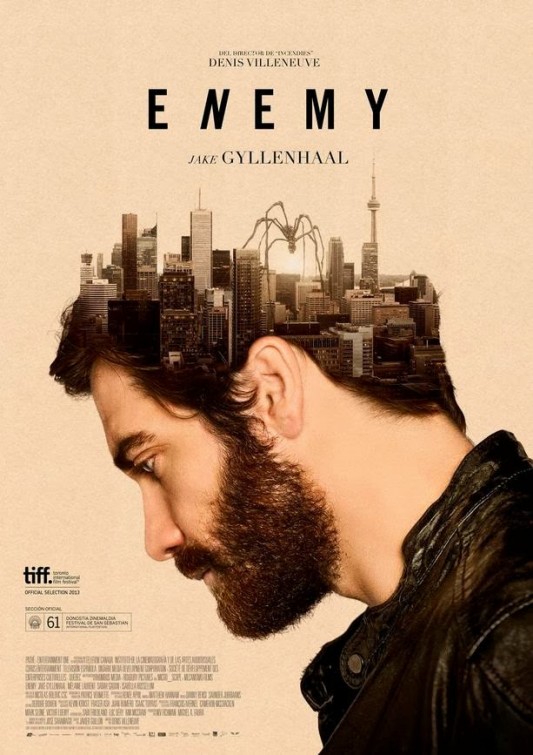
The Canadian-French filmmaker Denis Villeneuve’s Enemy (released as An Enemy) had a low-key release in 2013, but it quickly caught the attention of film critics and cinephiles across the world due to its ambiguous ending, surreal imagery, and a taut psychological thriller narrative. An added bonus was the Hollywood star Jake Gyllenhaal in a double role (in one of the last great doppelganger acting roles of all time). However, it was not a Hollywood venture. In fact, it was co-produced and co-distributed by Canadian, French and Spanish production houses and was, therefore, bereft of the mass scale marketing and publicity that usually accompanies a Hollywood studio film.
It is imperative that any discussion on Denis Villeneuve’s work should be preceded by an analysis of his filmography. Unless we understand his signature style, we will fail to truly appreciate the quality of his work in Enemy.
Unless one has been living under a rock the past decade, the name Denis Villeneuve should not sound unfamiliar. Which moviegoer hasn’t watched Sicario (2015), Arrival (2016), Blade Runner 2049 (2017), and Dune: Part One (2021)? But before he delivered the above-mentioned big budget and highly acclaimed Hollywood cult hits, Villeneuve was a little-known name at the box office (though considered as a maestro-in-the-making by film critics and experts of International Cinema, primarily on account of the uniqueness of his first three films).
Villeneuve made his film debut in 2009 with the hard-to-find-in-India and even-harder-to-watch-without-English-subtitles Canadian film Polytechnique (language: French). It was loosely based on a real-life Canadian tragedy known as the “Montreal Massacre”, in which an anti-feminist male shooter walked into a polytechnique in Montreal, Canada and shot dead 14 female students in 1989. But it was neither the subject nor the message that made this film one of the best debut films of all time. It was the treatment of the subject – or, what came to be known later as Denis Villeneuve’s signature style of filmmaking – that caught the attention of critics.
While his recent sci-fi films may have mostly conformed to a predetermined and monolithic visual style (blame Hollywood studio culture, not the maestro), Villeneuve’s first five feature films, especially, are the pinnacle of slow-burn narrative excellence that you will ever see on the big screen. These 5 films – Polytechnique (2009), Incendies (2010), Enemy (2013), Prisoners (2013) and Sicario (2015) – vary in subject and language and plot but have one element in common – “a sustained atmosphere of deep dread and relentless foreboding” that permeates every scene and penetrates deep into your skin. Labeling these five films as “thrillers” – as most cinephiles often do – would be doing a great injustice to the nuances of each of these. These five films collectively cemented his reputation as an auteur-in-the-making, immersing the viewer in slow, undulating waves of tension, making them feel unsettled instead of entertained.
His unique visual style of storytelling and this slow-burn tense treatment helped him win an Oscar nomination for his second feature film Incendies (2010). It was nominated for an Academy Award for Best Foreign Language Film and won critical acclaim and reverence all over the world. Incendies, which literally means “scorched” in French, is still regarded by some as his best work till date. It tells the story of two Canadian siblings – a brother-sister duo – who revisit their mother’s past by going on an investigative journey to her country of birth. The country is a Middle Eastern nation which remains unnamed throughout the movie, though it is not difficult to figure out that it is Lebanon (and its brutal civil war that lasted decades) that forms the background. The shocking truth of their mother’s past they end up discovering will change them forever. The “1 + 1 = 1” scene will leave you devastated, traumatized and shaken to the core. The opening scene, which shows a child soldier staring straight into the camera while his head is being shaved, is one of my favorite opening scenes of all time. The child’s cold, dark, piercing, emotionless gaze is one of the most terrifying scenes ever captured on celluloid, hitting the viewer straight in the gut with a powerful punch.
It would not be an overstatement to claim that in the world of cinema, the first decade of the 21st century belonged to Christopher Nolan – Memento (2000), Insomnia (2002), The Prestige (2005), Batman Begins (2006), The Dark Knight (2008), Inception (2010) – and the next decade belonged to Denis Villeneuve (Incendies, Enemy, Prisoners, Sicario, Arrival, Blade Runner 2049, Dune: Part One). Of these, Villenueve’s third feature film is the most intriguing and surrealistic of all. It’s simply titled Enemy.
Enemy is about a lot of things, and none in particular. It has a deeply unsettling plot, but that is not its biggest attraction. It has a stellar cast, riveting ambient music, a distinct Indie (art) film aesthetic, an ambiguous ending and surreal imagery involving … spiders! Not the mild web-weaving kind, but the giant Tarantula spider species which has scary-looking hairy legs.
The movie is based on the book El Hombre Duplicado (The Double) written by Portuguese author Josè Saramago in 2002. But the execution is vastly different from the book, and the treatment and imagery are entirely unique.
The entire film is based in Toronto, Canada and tells the story of two men who are identical in physical appearance but have diametrically opposite personalities. Jake Gyllenhaal plays Adam Bell, a mild-mannered college professor, who stumbles upon a man who looks exactly like him while watching a video film. Curiosity drives him to check out the doppelganger online. He finds out that the identical man is named Anthony Claire (also played by Gyllenhaal) and is a part-time actor. Curiosity turns into obsession, and Adam starts following Anthony, finds out his place of work, his apartment, and ends up talking to his pregnant wife Helen (played by Canadian actress Sarah Gadon) on the phone.
Next, he calls Anthony and tells him how much they look alike. Anthony dismisses him as a stalker, but his wife Helen gets suspicious and manages to hunt down Adam at his college. She is stunned at his physical resemblance to her husband but does not disclose her identity to him. Adam and Anthony finally decide to meet in a hotel room, they are both shocked to discover that apart from looks, they also share an identical scar. This scares Adam and he abruptly leaves the hotel room, but his entire world turns upside down when Anthony starts stalking him instead and spots his girlfriend, Mary (played by French actress Melanie Laurent of Inglorious Basterds fame).
Anthony comes up with a sinister plot. He accuses Adam of sleeping with his wife Helen and shames and manipulates him into letting him sleep with Mary as payback. He demands Adam’s clothes and car keys for a night, after which he promises to disappear forever. Adam complies. Anthony impersonates him and takes Mary to the hotel. But Mary notices a wedding-ring mark on his finger and instinctively realizes that he is an impersonator. They have a massive argument in the car while driving back home which results in a high-speed crash, presumably killing them both.
Meanwhile, Adam visits Anthony’s apartment and is welcomed in by Helen, even though she is able to recognise who he really is. She even has sex with him after he starts crying and apologizing in the middle of the night. She asks him to stay and makes her intentions clear that she prefers him over Anthony.
The movie ends with a shocking last scene. Adam is seen entering Helen’s bedroom, and instead of her, he finds a room-sized tarantula cowering against the rear wall. With a resigned look, he sighs.
This last scene has been debated and analyzed over and over by fans and critics alike. Did Helen actually turn into a Tarantula? What could be the possible explanation behind such a terrifying scene?
Before delving deep into the rationale behind the surreal imagery of the last scene, we need to consider 3 facts:
- The spider appears more than once in the film. Thrice, to be precise.
- The source novel by Saramago, from which this film is adapted, mentions nothing about spiders, or any form of surreal imagery or metaphors.
- There is a theory floated by many critics that the repeated occurrence of the spider in the film has its roots in Greek mythology.
Let us now dissect these facts one by one.
The repeated occurrence of the spiders
The opening scene of Enemy shows Anthony / Adam attending an erotic show at an underground club, which culminates with a naked woman on the verge of crushing a live Tarantula spider under her platform high heel.
Around the middle of the film, after the dramatic first meeting between Adam and Anthony takes place in a hotel room, a dream scene appears on the screen – first a naked woman with a spider’s head, and later a giant skyscraper-sized Tarantula walking against the Toronto skyline.
And finally, a pregnant Helen turns into a spider in the last scene.
Absence of spiders or visual metaphors in Saramago’s novel
Saramago’s novel is starkly naturalistic in its treatment of the plot. Which is to say, it directly contradicts the surreal environment created by Villeneuve in his film. In an interview with Gyllenhaal and Villeneuve that plays after the credits on Amazon Prime, the director said this about the spiders:
“To be honest with you, it’s not in the book, it’s not in the novel, and I’m not sure if Saramago would’ve been happy with the idea of having something that is so surrealistic in his naturalistic environment that he created in the novel.”
Why, then, were the spiders introduced by Villeneuve? This brings us to the 3rd fact – the theory floated by many – about tracing its origins to Greek mythology.
The Greek myth of Arachne
In the Greek myth of Arachne, from which the term arachnoid has been derived, Arachne beats Athena in a weaving contest. Athena strikes Arachne with intense guilt, which causes her to hang herself. When Athena sees her dead body, she feels sad about causing the girl’s suicide just because she lost a weaving contest. So, she turned Arachne into a spider, allowing her to weave for all eternity – just not as a human.
This myth serving as an inspiration for the spiders in Enemy is difficult to accept, not only because Tarantula spiders as seen in the movie do not weave webs, but also because Villeneuve himself suggested otherwise in an interview:
“It’s an image that I found that was a pretty hypnotic and profound [way] to express something about femininity that I was looking to express in one image. Because in the book you can use chapters to express something, but in cinema you have one shot, and the spider was exactly the perfect image.”
It may well be argued that Adam and Anthony are not so much identical twins as they are two halves of the same person. Adam suffers from Multiple Personality Disorder and sees hallucinations of himself. As the film progresses, he slowly spirals down into mental instability.
Villeneuve himself has hinted at a similar interpretation:
“You don’t know if they are two in reality, or maybe from a subconscious point of view, there’s just one. It’s maybe two sides of the same persona … or a fantastic event where you see another [self].”
The spiders, then, feel less like a literal function of the plot and more like an overarching metaphor. Each of the 3 scenes involving the spiders also features a woman. There seems to be a clear correlation between spiders and women in this film, especially the fear of a woman controlling a man. The ending of a pregnant Helen turning into a massive, horrific spider, reveals that the threat of being controlled by a woman still exists in Adam’s mind.
Enemy is a challenging exploration of the subconscious. Villeneuve exposes his own conflicted feelings towards women and monogamy in it. To him, the film is ultimately about repetition: the question of how to live and learn without repeating the same mistakes. He says:
“Sometimes you have compulsions that you can’t control coming from the subconscious … they are the dictator inside ourselves.”
One has to keep in mind that Anthony is an alter ego of Adam, a figment of his imagination and fantasy. Anthony’s wife Helen, therefore, is also an extension of this fantasy. In his subconscious, Adam gets his real-life girlfriend Mary and his alter-ego Anthony killed in a car crash, so that he could live with the fantasy wife Helen forever. But his fear of being controlled by a woman persists in his mind. Helen turning into a spider in the last scene is a metaphor for Adam’s deep rooted subconscious fear of being controlled by women. And Adam sighing at the sight implies his coming to terms with it. This makes Enemy a parable of what it’s like to live under the compulsions of the subconscious.
Certainly not an ordinary thriller.
Bio:
Prosenjit Purkait is a 22-year veteran of International Trade residing in Delhi and a freelance author. Presently self-employed, he devotes considerable time to his first love – cinema. His passions include coffee, literature and book reviews.
***
Like Cafe Dissensus on Facebook. Follow Cafe Dissensus on Twitter.
Cafe Dissensus Everyday is the blog of Cafe Dissensus magazine, born in New York City and currently based in India. All materials on the site are protected under Creative Commons License.
***
Read the latest issue of Cafe Dissensus Magazine, “The Other Mothers: Imagining Motherhood Differently”, edited by Paromita Sengupta, Director of Studies in Griffith College Limerick, Ireland.
 Cafe Dissensus Everyday