
By Soumyanetra
When I was in class 7 or 8, I think, we were asked to write an essay on Saraswati Puja. One of our classmates had just come from abroad and joined our school back then. She was a Bengali but was born and brought up abroad and her parents had just returned to settle down in India. I remember she wrote something along the lines of, that there is no such Goddess, and we imagined her to tide over our fears about studies and exams.
We were in a convent school, and we didn’t celebrate Saraswati Puja in our school. Neither were my parents very devout and celebrated this or any other Puja, for that matter in our home. But the Goddess of learning was worshipped with quite a bit of fervour and devotion in my maternal grandmother’s house and held a very special meaning for my mother, who had been part of it since her childhood.
Despite my not-so-close involvement, I was, like most other Bengali girls, an ardent devotee of the Goddess. So, my classmate’s essay left me and most of my other friends, horrified, disgusted and outraged at the sheer disregard and insolence that her essay depicted. Deeper down though, something in me told me that it could be true, and I saluted her inwardly for being so outspoken and bold, as I was rather timid, shy and obedient by nature.
Now, many years later, I am still unclear in my own mind as to why that essay was so disturbing. But I do realise that some things in life are best left unanalysed, unscrutinised, and undisturbed. They fill our senses like an unseen aroma of incense sticks and create a memory that brings back childhood scents and sensations, looks and laughter, feelings and beliefs, that are impossible to recreate later in our lives ever again.
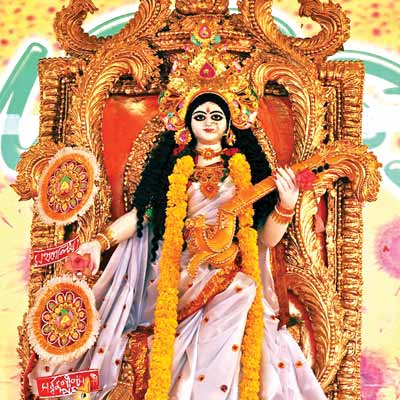
When I recall Saraswati Puja at my grandma’s place, I remember the big family get-together that surrounded it. My grandparents’ place was a huge, ancient three-hundred-year-old place in Hatibagan, where most of the house was occupied by tenants we didn’t know. The front portion was still ours where my grandparents and one of my uncles (mama) stayed with his family. The ground floor had the thakur dalan (space specifically meant for worship of Gods and Goddesses, though Saraswati Puja was the only Puja we celebrated) and the arches in the architecture of it made us kids always feel so royal. These were, of course, the permanent residences of the doves whose continual soft cooing throughout lazy afternoons made them even more lazy and drowsy. There was a permanent raised platform in the middle of it (for the Goddess to reside on) but most of the time the place wore an abandoned and desolate look, barring when we kids would be at grandma’s and would spend the afternoon playing hide and seek behind its pillars.
The celebrations actually started the day before, when everyone gathered there after the day’s work, and my younger mama and my dadabhai would travel to Kumortuli (not very far from Hatibagan) and bring the idol of Goddess Saraswati (quite a big one) with her face covered, in a rickshaw, both of them holding her tightly.
My elder mama who was based in Ranchi would come down with his family and that night everyone shared beds and stayed overnight at grandma’s place. Sometimes due to paucity of space, we would come back and go again very early next morning. The children would then draw alpona on the red floor. Saraswati Puja was so much of a fragrance to me – the fragrance of fresh flowers and chaaler guro mixed with the early morning winter smell. The smell of khichuri wafting out of the old kitchen window. Smell of freshly cut fruits for prasad.
More than the Puja, what I really remember is the scramble for flowers for pushpanjali from the plate that got passed around. The target was to make the flower reach the Goddess’ feet when we threw them at the chant of namostute. The big issue of covering one’s feet during shantijol sprinkling so that not a drop touches them. And of, course, the careful preservation of petals of marigold in the books that I kept during Puja. And the related issue of which books I should keep near the Goddess since there was space only for a few – we had to make space for all the books of my cousins as well as neighbours’ kids, all of whom converged at my grandma’s during the Puja and sought blessings and flowers.
When I tried to chant the mantras by phonetically imitating the mantras chanted by the priest, I did not understand them. Today, however, after having taken some Sanskrit courses, I understand them somewhat:
Bhadrakalloi namo nityang saraswattai namo namah |
Veda-vedanta-vedanga-vidyasthanebhyah eva cha ||
Esha sachandana bilvapatrapushpanjalih
Masyadharalekhanisahita aum aing saraswattai namah |
Roughly translated the first two lines mean, we send our obeisance to goddesses Bhadrakali and Saraswati and also to the Vedas (Rig, Sama Yajur, Atharva), Vedanta (Upanishads), Vedanga (Shikhsha, Kalpa, Vyakarana, Nirukta, Chhanda, and Jyotisha) and the Vidyasthanas (which literally means places of knowledge – connoting Mimamsa, Nyaya, Puranas, and Dharmasastras).
And the next two lines denote that we offer leaves of the bel tree (bilvapatra) and flowers along with sandal (chandana), and ink pot (masyadhara) and pen (lekhani), while paying obeisance to Saraswati and doing Namaskara.
Two more lines in the many lines of mantra that I find especially enlightening are as follows:
Sa maam patu saraswati bhagavati nihshesh jadyapaha |
Sa mey vasatu jihvayang veenapustakadharini ||
We pay our obeisance to Saraswati who ends all kinds of ill thoughts (nihshesh jadyapaha) and let her reside on my tongue (vasatu jihvayang) implying that she let me express only knowledge and wisdom and good words.
In other words, the mantras symbolise and invoke our reverence for all ancient knowledge and wisdom that our forefathers had gathered. They arouse our deepest respect for history and tradition and urge us to cleanse our thoughts and words. The essence of the mantras is much deeper and meaningful and what a tragedy it is that most of us chant them without understanding their true meaning.
Saraswati Puja brings back times I can’t go back to anymore. My grandparents are not there anymore, neither is my younger mama, nor my ma. My mother was a Sanskrit scholar and a sound academician and pronounced each mantra with clear understanding and knowledge. She devoted her entire life to the pursuit of knowledge and undoubtedly was the greatest disciple the Goddess could ever wish for. My younger mama though wasn’t great in academics and probably didn’t know Sanskrit either and yet I am sure there was no dearth of love and devotion in his heart for Her. Today they must be somewhere with the Goddess herself and she must be looking after them like her own children.
Bio:
Soumyanetra, Associate Professor, Economic Research Unit, Indian Statistical Institute (Kolkata).
***
Like Cafe Dissensus on Facebook. Follow Cafe Dissensus on Twitter.
Cafe Dissensus Everyday is the blog of Cafe Dissensus magazine, born in New York City and currently based in India. All materials on the site are protected under Creative Commons License.
***
Read the latest issue of Cafe Dissensus Magazine, “The Other Mothers: Imagining Motherhood Differently”, edited by Paromita Sengupta, Director of Studies in Griffith College Limerick, Ireland.
 Cafe Dissensus Everyday