
By Neera Kashyap
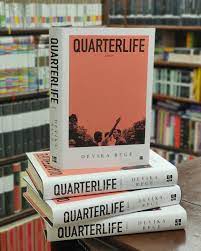
Replete with Indian contemporary issues – issues of evolving filial relations, politics, power, caste inequalities and violence – Devika Rege’s debut novel, Quarterlife implodes in the reader’s mind because these themes are familiar and thinly veiled, yet so well researched that they bring forth a reality that is almost discomforting to confront. In an article Rege wrote for The Indian Express (January 20, 2024) titled, ‘How did we get here’, she writes: “I have spent the better part of a decade writing a novel about young Indians arriving at their politics. The story is an attempt to understand how, around 2014, our political identities became all-encompassing in a way that they had not been before, and what this meant for the spread of Hindu nationalism. Since the work is set in a real-world context, it called for years of on-ground research to understand why people felt the way they did. Besides this, every headline I read, debate I encountered and public event I witnessed recalibrated what I made of my subject.” In this constant recalibration, Rege traces several issues to their roots: the search for identities and values in contemporary living and the shocks these unleash; the origins of religious and political intertwining; the causes of family ruptures and rapprochement; the subliminal feelings of Dalits and half-castes; of educated and semi-literate minorities; of impassioned nationalists; of gays with their struggles of coming out in the open.
The story has its setting in Mumbai in the family of Raghu Agashe – a hard-working middle-class family that has come into wealth and good living by selling off their village land in Talne on the Konkan coast, to a mining industrialist. Raghu Agashe’s sibling Ravi does not sell off his inherited share of the land due to his conviction that mining would damage the hills and erode the natural livelihoods of people.
Raghu’s brilliant older son Naren studies at IIT and Wharton to become an investment banking consultant in America, encounters professional and cultural prejudice as a non-white, hits the glass ceiling and returns to India. His hope: with the elections and a new government, with talk of India leading the century and with the protection of family wealth and networks, he would fit well into the system as an associate partner with an international consulting firm. As he returns to India, he invites as a house guest to his family home, Amanda, an American co-student with whom he had shared a sub-let – platonically. Amanda is from Jaffrey, a small American town where nine generations of ancestors have lived, wrestling back woods to lay down their farms. She comes to India on an Impact India fellowship to work in Deonar, a Mumbai slum, hoping to discover an identity that lies beyond the ideals of a safe, decent, hard-working close filial tradition.
Raghu Agashe’s younger son Rohit runs a small film studio with two partners, is charming, highly networked and energetic, but is searching for an identity that goes beyond charm and superficial living – his explorations taking him to his family roots and estranged relatives, to regional characters for their authenticity, and to the pulsation of Hindutva networks and passions. Rohit and Amanda’s lives become closely intertwined both sexually and through the buffeting encounters of east and west lived out through love and hate, attachment and conflict, rupture and transformation. Ravi’s son, Kedar is the counter to good living, becoming, as a journalist with a language newspaper, the investigator of causes of inequality and class conflict.
Rege expands this world of Naren, Rohit and Amanda to include their many friends and, in turn, ever-widening circles of people to unveil how people from different castes and communities experience the world. She writes: “I asked myself what it says about a novel that critiques social inequality if it is told from the point of view of only three characters: one white, and two upper-caste. How would it change the plot if I brought in a greater diversity of voices? I didn’t know, but I wanted to find out. That is why the perspectives in the novel go from three characters to nine to those of a whole city on a night when it descends into violence. The way the story unfolds reveals its own expanding democratic consciousness.”
Through the eyes of Rohit’s business partner Gyaan, we see modernization as a reason for the rise of both incomes and religious revival, when things change so fast people need beliefs to hold to – the majority buying in to their own religion, now tantalizingly on offer. Gyaan’s sweetheart Ifra, an educated and professional Muslim woman from a wealthy family, thinks: “When did all of them jell into one monstrous fist with its index finger pointed at the only group left out? How long before that finger curled around a trigger?” Omkar, a Kunbi Marathi cinematographer befriended by Rohit, and a fervent believer in the Hindutva-oriented Bharat Brotherhood, feels humiliated by the informed questions asked of him by the mainly upper caste well-to-do group in Rohit’s ‘den’. His general hold is on the thought, “Who am I but a poor boy of the black earth of Wai, yet what I am is up front, and I can stand anything but I can’t stand fake people.”
Cyrus, a Parsi, an actor and Rohit’s second business partner, is gay. Since disclosing his sexual orientation to his parents, his preoccupations are revealed as: “He knew that coming out was not a one-time chat, but would involve multiple scenes and subtle reconfigurations until love prevailed. How had things gotten worse instead?” Manasi, who is Naren’s lover and Rohit’s old friend from school, is half Dalit. As a gold medallist and a successful corporate professional, she bears the vexed silence of being half-caste: “She has never found the words to talk about her MBA professor who mocked students who couldn’t solve a maths problem by asking if they had come through the quota, or how hard she worked for the gold medal, unsure of whether employers looking at her CV would write her off for her surname.”
This web of characters and their onward worlds has interconnections that holds the storyline together. It exemplifies in nuanced ways the strains in the current political discourse through their psychologies, the rising conflict between them spawning newer, more intricate concerns. Because the web is finely woven, an after-dinner debate among the above persona in Rohit’s den, though densely packed, moves from logic to polemics to the personal in ways that cause deep hurt, even rupture. As in Yeats poem, “Turning and turning in the widening gyre/ The falcon cannot hear the falconer;/ Things fall apart; the centre cannot hold”, at two climactic moments in the novel, Rege lets the centre of the web come apart, so that the rupture unfolds in ways that intensifies the tragedies, yet creates such heart-searching that lives change forever.
For this to happen, Rege uses intense research to build the psychology of each character by creating situations that will allow them to unfold/evolve through both exterior and interior landscapes. She is as authentic in creating the scene inside Omkar’s half-finished village home as she is in creating a dynamic boardroom scene where, Naren as associate consultant in an investment firm, presents a financial proposal to a client. Using the techniques of literary modernism, the interior is as deeply explored as the exterior.
In an intimate moment with Manasi, Naren says, “When I caught the flight to India, I was acting on instinct. I thought it might help to be rooted in my culture, or closer to family, or that working for my country would take the focus off myself. I thought, when there is no goal to occupy us, our hands go to our throats. But I didn’t need just any goal. I needed new values, because values give the goal weight……now I have new values, and in them, I accept the world for what it is and that I must situate myself in a place where the system works for me.” On the other hand, Omkar, in his bid to escape small town hopelessness and mediocrity, espouses both Hindutva and shooting a film on the deity Bappa as avowed passions, not just fitting in. To Rohit he says, “My film is not propaganda. When I am shooting, I have no thought that I am an Omkar, a Khaire, a class or caste Hindu. I am the camera.”
Rege also uses different styles for different characters. Because Amanda is a photographer who must document the slum project visually too, the Amanda segments have subtitles in caps which read: Shut up or be careful; Ramzan in Deonar; The People who can’t leave; The myth of Sheela; The beach is empty – these vignettes clubbed under the major heading: Amanda, Towards Purpose.
While all of Rege’s characters suffer it to a greater or lesser degree, the real clash of civilizations is Amanda’s. When the slums’ filth, the scarcity, the broken assemblage of homes and lives overwhelm her, her mind goes blank. She suffers from an unrelenting fever and is hospitalized. But “more than specific incidents what exhausts her is this shuffling between safe places being alert, alert, alert, and her constant sense that, despite her kurtas, the crowd is watching her as singular while she sees it as a crowd. Can you feel so isolated and so exposed at once?” she asks. At a deeper level, she comes to understand that she came to India for the beautiful empathy it would generate in her, for the Christian sentiment of doing service – impulses that become so powerful that she is blind to the complexity of cultural difference, spawning a tragedy for which the guilt never leaves her.
The night of the immersion of the Ganapati Rajas is one of Rege’s most brilliant scenes in the book. As observer from a high-rise building Wadala building, Gyaan describes the scene to his mother on phone: “Look at the cops, the barricades, the bloody army. This is a contained act of aggression, a valve on a pressure cooker to let off steam.” As participants, an office boy couldn’t care less whether he walked on roses or sewage; an old Koli woman’s triumphant smile opens on long teeth as she nabs a garland flung from Bappa’s float, assured of keeping that garland for years.
Interspersed between the sights of lights, drumming, celebratory slogans, dances and the movement of floats, is the foreshadowing of communal violence – a rumour that spreads like wildfire; furtive movements in preparation or self-defence; roadside group incitement. At the Chowpatty beach, there is no room even to stand. As the Rajas are lowered into the sea, the frenzy that grips the crowd is also the frenzy that grips Rohit. Both Rohit and Amanda see the gulf between them, just before the tragedy occurs. Like in the living room debate, here too, the web’s centre does not hold. The rupture is so complete, it changes every character’s life. It is much later that Rohit sees: “No one saw it coming, yet he can’t accept that it was a freak occurrence, and whenever he recalls these events, they play out on that single night that exemplified the mood of the hour and held at its fulcrum all their tragedies.”
Throughout the novel, Rege uses at appropriate moments poetic imagery to render distilled moments of observation. At the end of Ganeshotsav, she observes the moment through the eyes of a mandal volunteer: “Bappa has danced His way through us, He is focused on the infinite, and until He comes again, our hearts are desolate. The receding tide leaves a frill of rotting garlands, cigarette butts and the broken limb of an idol at his feet. By the bruised light of daybreak, the Raja of Lalbaug is lowered in the sea, and the city has been pacified.” Rege’s essential strengths are both her deep research and her razor-sharp observation that makes a mandal committee meeting come as alive as a terrace party of young people from showbiz.
Rege is a courageous writer who has shown the reader a mirror of our times with honesty and without judgement. In an interview to The Indian Express (November 28, 2023), when asked if she was concerned about backlash or misinterpretation in this politically charged work, Rege replied: “I’m not naïve about the possible fallouts even for those who have the privilege of writing a novel in English, but India isn’t China yet, so there’s still room to take your chances. What I felt more acutely was a sense of responsibility towards the communities depicted in the novel. Every incident of caste or gender violence or religious bigotry felt like a tightrope between whitewashing the evils of society or going so far in a description as to reinforce them. There’s no easy resolution. I suppose you just go at the task with as much integrity as you can.”
Bio:
Neera Kashyap has published a book of short stories for young adults, ‘Daring to Dream’ (Rupa & Co. 2004) and contributed to several prize-winning children’s anthologies (Children’s Book Trust). As a writer of poetry, short fiction, book reviews and essays, her work has appeared in national and international literary journals and poetry anthologies. Her essays and book/theatre/film reviews have appeared in The Chakkar, Café Dissensus, Bangalore Review, Mountain Path, Kitaab, RIC Journal, Quiver Review & Countercurrents.
***
Like Cafe Dissensus on Facebook. Follow Cafe Dissensus on Twitter.
Cafe Dissensus Everyday is the blog of Cafe Dissensus magazine, born in New York City and currently based in India. All materials on the site are protected under Creative Commons License.
***
Read the latest issue of Cafe Dissensus Magazine, “The Other Mothers: Imagining Motherhood Differently”, edited by Paromita Sengupta, Director of Studies in Griffith College Limerick, Ireland.
 Cafe Dissensus Everyday