
By Nishi Pulugurtha
Gopal Lahiri has been writing poetry for several years now and has many volumes of poetry to his credit. A geologist by training and profession, Lahiri is a bilingual poet, translator and critic as well. His poems have been anthologized in several poetry anthologies in the recent years.
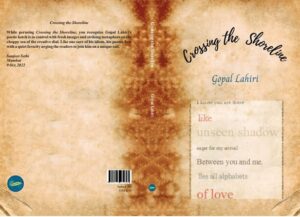
Crossing the Shoreline is an interesting collection in that its one hundred poems include several haiku, senryu and haibun. It must be noted that Lahiri has, in the past, a volume of form poems, Return to Solitude and so it is interesting to note the form poems present in the volume under review as well. The volume is divided into four sections: Voices of Concision, 14 Liners, Haiku and Senryu and Haibun. Voices of Concision, the first section of the volume, has thirty-five poems. The first poem, “Crossing the Shoreline” speaks of the self in an idiom that is simple and effective.
Unknown alphabets draw humpbacked sand dunes
aligned in endless rows on the shore
of my sleep.
Darkness, sleep, dreams, the unknown lead on to questions of the self and what it really means. The idea of a poem, the birth of a poem is something that “Half-formed Poems” speaks about:–
Listen to my past,
nights turn into half-formed poems.
There are several poems that refer to stories, to conversation and to alphabets that remind one of the title of Lahiri’s earlier volume of poems Alleys are Filled with Future Alphabets – poems like “Start Again”, “Love Alphabets” and “Stories”, for instance. “Long Read” speaks of “unknown palmprints” that seem to dance as stories come to life.
You dance to the sameness, collect red yellow synonyms
and when I do not want to go on with more words
you write long-read stories in dark blue ink.
The second section, 14 Liners, consist of fourteen-line poems written in a variety of forms and line structures. While some have a racy pace that prances as it moves thought and feeling ahead, there are some that have a lingering effect that lilts and moves gently. In “Randon Reflections”, it is a musing mind at work as thought comes together with expression to weave a tapestry of words:
My diary pages are open all night inside
the dark drawer.
And I learn to burrow in eth dark yet
I shudder from where the Universe begins.
“Ancient Lights” has a kind of urgency as the short pithy sentences of each line rush through,
Blood moon giving
a morsel of words
The fourteen-line poems have several forms that Lahiri uses – in some the lines are arranged in two lines forming a unit, in some there are four line units, in others he uses two equal seven line units and in some six and eight line units. The poems reveal an experimenting mind trying to juggle several ways of expression. “Soul Music” uses an eight line and six-line form with the first stanza, of eight lines, speaking of language and of words. The last six lines go on to speak of colour, of shapes that fashion some music.
Skies now holding various shades of colour
The flowers blossom, fragrance spreads.
The metre and rhyme scheme varies, with several poems written in free verse as well in this section.
The section, Haiku and Senryu, takes readers into the world of form poems where brevity of expression come together with beautiful images that stay on. Lahiri is a poet who has worked with this form, and it is interesting to see the evolution of his poetic art in the form poems in this volume. He does not adhere to the conventional syllable count that one notices in these form poems rather experiments and varies the syllable count according to the theme and subject matter of the poem. What stand out are a series of beautiful images and metaphors that reveal the poet’s art.
wine-dark eyes
confounding deeds
end of summer
The presence of modern-day ideas and idioms is an interesting aspect of this section,
#instaphotos
chasing my wee hours
dream lags behind
Five haikus and senryus are arranged on each page and this reviewer is of the opinion that this way of arrangement of these poems leads to a crowding of images. A haiku is like a painting, one with words and it is important that the reader savour each one separately, individually, for some time to enjoy it completely.
The section on Haibun, the last section, is a small one, with five haibuns that reveal a beautiful coming together of prose and poetry, in both images and feelings coalesce. The prose part of the haibuns reveal a poetic mind at work as Lahiri’s prose turns out to be very evocative. In this section too, one sees experimentations as the haibuns are given names and one of them has multiple verse and prose forms intertwined as well.
Crossing the Shoreline reveals a mature poet working on his craft and fashioning new forms in ways that only a prolific poet can. His felicity with Bengali and English, the two languages he writes in, brings in layers of new forms of expression. The title wonderfully brings in what this reviewer feels is an important facet of the poems in the volume, the crossing over, the reaching out, the going beyond the conventional to create poems that while being referred to their conventional names go beyond the expected. This sense of the unexpected is a hallmark of Gopal Lahiri’s poetry. The themes that come together with the myriad experimentation are about life, love, longing, desires, poetry, conversations, the angst of life that haunts and disturbs, the very momentum of life. Lahiri also works with images that are conventional and otherwise to create new layers of thought and expression. The volume also has some sketches, ink on paper, that appear at times as one reads through, creating pauses that help one read and think as they move ahead.
Bio:
Nishi Pulugurtha is academic, author, poet and occasional translator. Her publications include a collection of essays on travel, Out in the Open; an edited volume of essays on travel, Across and Beyond; three volumes of poems, The Real and the Unreal and Other Poems, Raindrops on the Periwinkle (Writers Workshop, Kolkata), Looking (Red River 2023); a co-edited volume of poems Voices and Vision: The First IPPL Anthology, a collection of short stories The Window Sill, an edited volume of critical essays, Literary Representations of Pandemics, Epidemics and Pestilence (Routledge, 2023). Her recent book is a volume of essays written during the pandemic, Lockdown Times. She is the Secretary of the Intercultural Poetry and Performance Library, Kolkata and is member, Advisory Board, Alzheimer’s and Related Disorders Society of India, Calcutta Chapter.
***
Like Cafe Dissensus on Facebook. Follow Cafe Dissensus on Twitter.
Cafe Dissensus Everyday is the blog of Cafe Dissensus magazine, born in New York City and currently based in India. All materials on the site are protected under Creative Commons License.
***
Read the latest issue of Cafe Dissensus Magazine, “The Other Mothers: Imagining Motherhood Differently”, edited by Paromita Sengupta, Director of Studies in Griffith College Limerick, Ireland.
 Cafe Dissensus Everyday