
By Somudranil Sarkar
“Happy is the man who finds a true friend, and far happier is he who finds that true friend in his wife.” – Franz Schubert
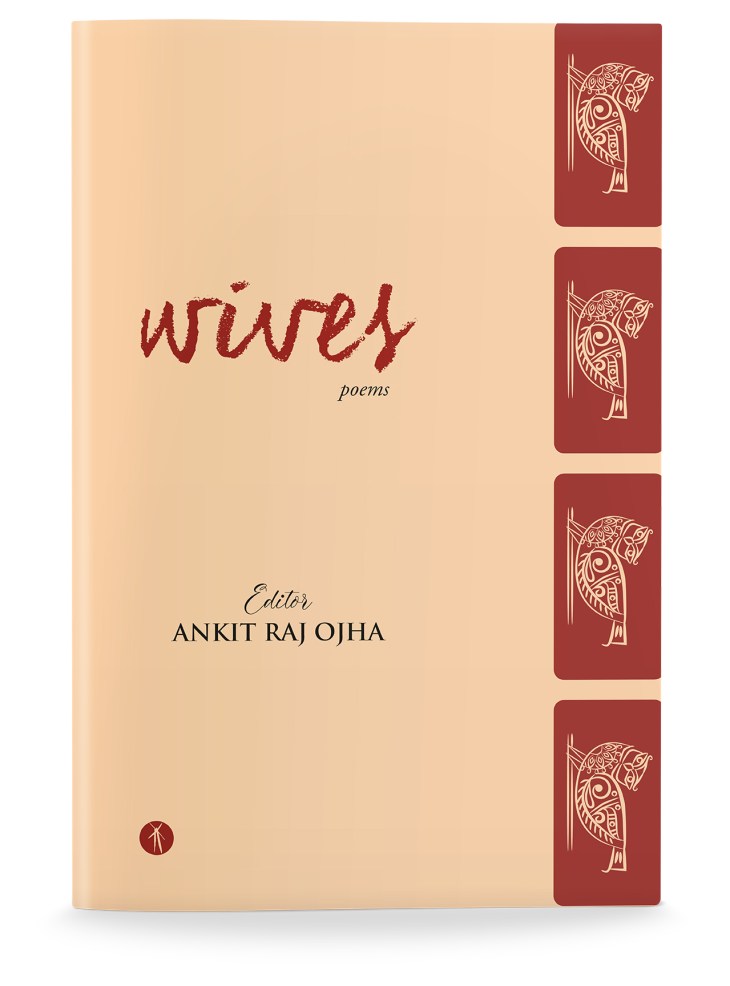
Although the Austrian composer said these ages back, it still stands true. Respecting and acknowledging secrets and choices will be attuned through friendship. Speaking an unknown tongue, discovering a language side can be serendipitously joyous. The key to treading that itinerary is through acceptance. Regardless of the set of courses, even if it is bumpy, acceptance is the key to resolving that. Hawakal’s Wives is a unique collection that endorses it. The anthology edited by Ankit Raj Ojha carries poems of forty-seven poets – 48 including Ojha’s own contribution – from 12 countries across the globe. The number is a significant one in both science and religion: in science, 48 makes up the symmetries of a cube, while in the Jewish oral traditions, 48 happens to be the number of ways through which the Torah wisdom is attained. Dr. Ojha brilliantly merges the philosophical concept with other tangents of wives.
The collection, Wives, includes varied types of poetry, ranging from rhymed verse, free verse, prose poems, and visual poems to sonnets, elegies, odes, satires, haiku, sequence poems, and villanelles. In these poems, the poets talk about love, betrayal, longing, space in marriage, and so on. In Rahul Gaur’s “Roleplay,” the poet disregards the patriarchal phenomenon endorsed by Kautilya:
For twenty-two centuries,
she has been trying
to break this patriarchal straitjacket
and be herself
for just twenty-two minutes
each day. (“Roleplay”)
For “Twenty-two centuries,” as the poet says, women have been tirelessly trying to break through the patriarchal male code. Even time is rationed by a husband assisted by societal norms. A wife juggles work every single day to satisfy someone or the other. However, her personal choice goes astray. Gaur expresses his dismay at this, and the politics of time that he deals with in this poem is extraordinary.
When words between a married couple transition into a “hmm”, their worlds collide, and all that is left is a wide-open space. However, open spaces are vast and safe, which in turn instils a sense of serenity. As D.C. Nobes writes in his poem,
“Hmm?” I say in reply
not so sing-song
prosaic instead. (“Humm”)
However, it is said that the scheduled exchange of words and making love become a mundane affair in the mundane daily life of a married couple. If they can communicate in fairness through a ‘sing-song’, as Nobes says, they might end up finding meaning in their daily life.
Talking about daily life, it would be an injustice to not mention John Grey, who nonchalantly pens down a piece, “I’m Grocery Shopping”, which reads like an interior monologue. He writes, “Of course, usually my wife does this.” Since she is ill, he has to undertake this activity. He doesn’t provide the detail of the objects but rather of people:
And look…isn’t that Fred?
Is his wife sick too?
No, I remember, he’s recently divorced.
He must be here for real. (“I’m Grocery Shopping”)
Grey’s apprehension is clearly visible. He doesn’t want to be seen. Is there a patriarchal stereotype that women should do the shopping for daily needs while men would sit back at home and chill? Or is there something else? Noticing “Fred,” who might be just another face, he becomes alert. Maybe what Grey shops is – fears. Fears about being asked too many questions about his wife, the reason for him coming here, and so on. Skimming through all the product details, his trepidation becomes amplified. While his body is at the place of shopping, his mind is lodged at someplace else.
Some wives adhere to blank stares and avoid interaction in crowded commutes; otherwise, it would be regarded as sleazy. This thought gets instilled subconsciously due to the repeated surveillance by her husband in terms of interrogation. However, some husbands feel the same way. As substantiated by Onkar Sharma:
Once more, without a fault of mine I am under scrutiny.
I stand mute, struggling to guess about an unknown mistake.
At last, her doubtful contours and melancholic, dainty gaze reveal
that she’s again seen me in the company of a strange woman,
quite possibly sharing hugs and kisses,
quite possibly walking hand in hand,
or maybe by the riverside sunset café. (“Wifey Dreams”)
This situational discomfort puts husbands like Sharma under pressure, as even dreams can be menacing. There are times when it takes a toll on the husband’s health due to anxiety. However, this dubious facet makes him love his wife more. This sometimes paves the way for anchorage, thereby allowing the relationship to evolve.
Providing space in a relationship is very important. In psychoanalytic theory, Jacques Lacan talks about a particular thing that goes by the name of objet petit a – the incompleteness in human beings that leads to desire. Our demand for things never ceases to exist. It keeps passing from one thing to another. If one notices a ratio of arranged marriage to love marriage, the latter goes through separation/divorce much more than an arranged one. It is so because in a love marriage, the desire to provide space to each other is not endorsed, while in an arranged marriage, a certain detachment remains ingrained from the very beginning. If we take a quote by Rilke, this would be substantiated: “Once the realization is accepted that, even between the closest human beings, infinite distances continue to exist, a wonderful living side by side can grow up, if they succeed in loving the distance between them which makes it possible for each to see the other whole and against a wide sky!”
The above philosophical facet is very deeply embedded in Tabish Nawaz’s poem:
I spin threads to suspend
the crumbs of our conversation,
enmeshing the inevitable from dragging us down
into the serenade of the black holes
circling within the space between us. (“Dissolution”)
Beyond the “black holes” remains the space-time singularity, where Nawaz wants to head. There isn’t any place or time, just reverberating under the aegis of the English rock band Pink Floyd:
We’re just two lost souls
Swimming in a fish bowl
Year after year
Running over the same old ground – “Wish You Were Here”, Pink Floyd
Mark J. Mitchell’s poem “The Wife of the Saint” is replete with biblical allusions. However, beneath the theological surface lies an inherent sorrow. Mary Magdalene rests in the background, as Mitchell writes,
The wife of the saint never gets thanked.
She suffers—humble, deep in the background
of holy portraits. No one ever sees quick sorrows
painting her blank face. (“The Wife of the Saint”)
It is deeply heartbreaking to give and feel love in a situation such as this. To quote from the web series, Fleabag:
Love is awful. It’s awful. It’s painful. It’s frightening. Makes you doubt yourself, judge yourself…It’s all any of us want, and it’s hell when we get there! So no wonder it’s something we don’t want to do on our own.
Just when you think the longing that one might harbor would bring only pain and nothing else, Mitchell says, “Eternity’s long. She just has tomorrow.” Even if one hasn’t received love for long, one still dreams of a better future. However, the woman whom Mitchell is hinting at, whether its Mother Mary or his beloved, only wishes to be seen “tomorrow.” She does not fancy an everlasting future.
In Kiriti Sengupta’s “Troth,” the poet derives the character Allison from the movie The Notebook, which is also based on the book of the same name. His apprehension entails the “cross-examination” that his wife might conduct like Allison. In the movie, the character Allison suffers from memory loss and cannot recognize her loved ones. Sengupta fears her departure based on deluding reality will suffer from remnant longings.
She guards two pairs of bangles:
coral and conch.
Missus ensures they are intact.
She fears a chink will curtail my breath. (“Troth”)
In Bengal, the tradition of wearing “coral and conch” bangles by married women is common. In the poem, the crack “will curtail my breath” is something that shouldn’t be taken literally. The underlying meaning can be sporadically tapped where the bangles vis-à-vis the well-being of a husband, are writ large. The phallocentric fear structured by societal constructs preys on the wife. A crack shouldn’t paralyze both parties’ vows during the marriage ceremony. There can be cracks in dialogues, but exchanging fears, anticipation, and pleasure should be led by trust.
Rajorshi Patranabis’s “Canvas” traverses a cosmic itinerary through colors:
I felt her sitting with her feet immersed in violet,
Violent strokes, peacefully habituated,
When, suddenly, was doused in white,
A brush of neutrality. (“Canvas”)
With selective colorization, one object is tinted while the rest remains the same; it is the riot that one can lead. One can rebel and spread like a virus. Patranabis defies the collective cacophony and digs deeper into a political level. On the surface, it can appear as a piece dedicated to his spouse, yet it is all about choosing sides at a deeper level. The redness on her feet that had once existed from red dye during the marriage has now changed “her feet” to “violet.” From the redness to the clotted “violet,” the poet notices the “white,” a “neutrality” that evinces helplessness.
The collection is filled with varied forms, and one among them is Sudeep Sen’s Diptych:
We are mere stardust of an ancient
supernova — one that gave
us our metal, blood, and breath. (“Day Before Summer Solstice, Diptych”)
Mere specks can create constellations in the galaxy of wilderness. Sen’s form evokes the stillness through “solstice.” Like the explosive throes led by a star, the supernova to Sen is the passion that allows one to wait for ages. It is like waiting for an unknown “Godot” as time seduces time. However, the testament, which is a scripture, is nothing but words that fade and explode into oblivion, from nothing to nothing – hinting at the Big Bang theory. But the years allow him to sit by the window and stare into the galaxy with his naked eye, with his spouse by his side that possibly binds them with “metal, blood, and breath.”
Wives is a unique collection. Ankit Raj Ojha has curated and edited this wonderful collection with such finesse that it demands special attention. It celebrates androgyny besides the love for the spouse. Bitan Chakraborty’s cover deserves a special mention, which is inspired by the South Asian art form, Alpona. In the age of ChatGPT-generated emotional repositories, these poems display variegated forms to demand an audience.
Bio:
Somudranil Sarkar, a theatre artiste for over twenty-one years, is a postgraduate in English language and literature. He published C/O Bonolata Sen, a collection of short stories, in 2019. His work has appeared in Strange Horizons, The Critical Flame, World Literature Today, and elsewhere. In addition, Sarkar often curates workshops on theater and pantomime. As a performer, he meddles between the esoteric and the unexplored itinerary.
***
Like Cafe Dissensus on Facebook. Follow Cafe Dissensus on Twitter.
Cafe Dissensus Everyday is the blog of Cafe Dissensus magazine, born in New York City and currently based in India. All materials on the site are protected under Creative Commons License.
***
Read the latest issue of Cafe Dissensus Magazine, “(Re)storying Indian Handloom Saree Culture”, edited by Anindita Chatterjee, Durgapur Govt. College, West Bengal, India.
 Cafe Dissensus Everyday