
By Kiran Balyan and Shafiq Ahmed
India has celebrated its seventy-sixth Independence Day. If we look back at India in 1947, India has come a long way. The improvement is not restricted to a few domains or regions; it is indeed multidimensional, starting from the development of Indian Railways in 1951 to becoming one of the fastest-growing economies in the world in 2023. India is now preparing for cutting-edge technologies, including 5G, Artificial Intelligence, blockchain, augmented reality and virtual reality, machine learning and deep learning, robots, natural language processing, etc. Moreover, the decline in poverty, increase in employment, acceptance of women in workplaces, provision of better education facilities, and enhanced safety and security measures point to the progress of India towards becoming a better nation.
A Bird’s Eye View of NCRB Report, 2021
According to the NCRB report, 2021 (released in August 2022), compared to 2020, there was a 7.6% overall drop in reported crimes in 2021. The crime rate per lakh population dropped from 487.8 in 2020 to 445.9 in 2021. National Crime Record Bureau (NCRB) was set up in 1986, based on the recommendations of the National Police Commission (1977-1981) and the MHA’s Task Force (1985), under the Ministry of Home Affairs to function as a repository of information on crime and criminals to assist the investigators in linking crime to the perpetrators. NCRB brings out the annual comprehensive crime statistics across the country (‘Crime in India’ report). Having been published since 1953, the report serves as a crucial tool in understanding the law-and-order situation across the country. Hence, the NCRB report is an important document not only for the government and police departments but also for the citizens of the country to come face to face with the reality of the country we live in. Even though the overall crime rate has declined in India, the crime rate in 2021 is significantly higher from 2019. And in a few categories of crime, the situation is the opposite. According to the most recent data from the National Crime Records Bureau (NCRB), overall incidents of crime have increased in the following categories:
- THE CRIME AGAINST CHILDREN
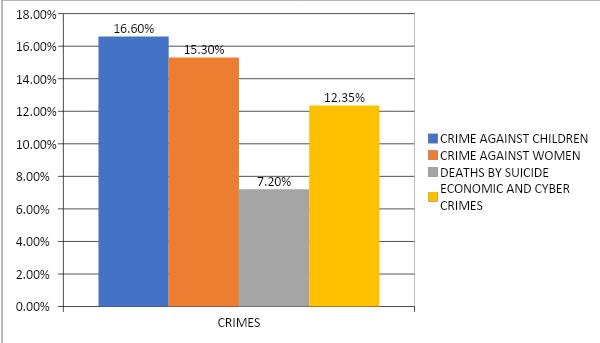
Overall, incidents of crime against children increased by 16.2% in 2021 compared to the previous year. According to the NCRB report, 53,874 or 36.05 per cent of the 149, 404 cases against children reported in 2021 were under the purview of the Protection of Children from Sexual Offenses Act (POCSO). With a rate of 48.6, Sikkim has the highest rate of sexual offences against children, followed by Kerala, with 28.1. In 2021, Uttar Pradesh (7,129) had the most cases under the POCSO Act filed.
Among union territories, Delhi had the highest rate of crimes against children in 2021.
- THE CRIME AGAINST WOMEN
Recent statistics show that crime against women increased by 15.3% from the previous year in 2021. According to the NCRB report, the number of crimes against women grew from 56.5% in 2020 to 64.5% in 2021 (incidents per 1 lakh population). The majority of these situations fall under the category “Cruelty by a spouse or his relatives” (31.8%), which is followed by “Assault on a woman with an aim to outrage her modesty” (20.8%), kidnapping and abduction (17.6%), and rape (7.4 per cent).
The report states that Assam has the highest crime rate against women in 2021.
- THE DEATHS BY SUICIDE
The number of suicide deaths has risen in India by 7.2% compared to 2020, with a total of 164,033 deaths by suicide in 2021. Research published in the Lancet in 2021 stated that “India records the largest number of suicide deaths in the world.”
The highest percentage increase in suicides compared to 2020 is reported in Telangana (26.2%).
- THE ECONOMIC OFFENSES AND CYBERCRIME
Economic offences, including financial fraud and property fraud, increased 12.35% in 2021. According to the NCRB, the Chandigarh Police has a 77.3% pendency rate for economic offence cases.
There has been a sharp increase in cybercrime cases in Delhi. According to data, the number of incidents of online fraud, online harassment, the publication of explicit content, etc., increased by 111% in 2021 (356 cases) from 168 cases in 2020.
This is only one side of the coin. The actual reality is crueler and harsher than what is depicted by the NCRB report. Despite so many laws and various special provisions for the security and safety of citizens, the number of crimes in our country is enormous. Even with the presence of a large police force in the country, the relationship between the increase in crime rate and the increase in police force seems to be going parallel to each other, and the statistical data validate this. Uttar Pradesh has one of the largest police forces, not only in the country but in the whole world, having approximately 2.5 lakh police personnel spread across 68 district police departments. But this has not impacted any change in the crime rate as even with such a large police force the state tops the list of reported crimes. The same situation is evident in the state of Maharashtra as well. One of the causes of such ineffectiveness of the police force can be due to the use of fear and not the proper communication by the police. Fear can only suppress crime for some time; it cannot eradicate it permanently. This is the reason why crimes reduce when police are in action and incidents of crime increases as soon as criminals get an opportunity to commit crimes. A very recent example of this reality was seen in Madhya Pradesh, where a man who was sentenced to ten years of imprisonment for raping a girl in 2012, ended up raping another minor girl as soon as he came out. This shows that even after spending so many years in prison, there was no change in the mindset of the person.
Causes of Collateral Damage and Collective Failure
Regardless of the incredible technological development and advancement, we have failed to bring about a mental revolution in the country. We are still living in a society where victims are tortured more than the culprits, and this is the reason for the surge in unreported crimes. As a result of this dismissive and pessimistic societal response, people don’t feel free to speak out against the injustice done to them. This has paved the way for an increase in the number of crimes and a decrease in the number of reported cases.
Studies have shown that up to 60% of crimes go unreported in our country, with sexual assault and harassment of women being on the top of the list of unrecorded crimes with 99%, followed by child abuse with 98%. There are many other categories of crimes in which the rate of unreported cases is also high, such as crimes against scheduled caste, scheduled tribe, poor, cybercrimes, gender discrimination, caste discrimination, etc. However, due to the lack of availability of information, as FIRs are not registered properly, or the victims feel helpless to approach the police, it is hard to estimate the number of unreported cases in the categories mentioned above.
The crime rate shown by NCRB is not completely unerring; the reason being that it is calculated using the ‘Principal Offense Rule’, as a result of which the actual count of each crime head may be under-reported as among many offences registered in a single FIR case, only most heinous crime (maximum punishment) will be considered as counting unit. On top of this, the NCRB doesn’t collect the data for the report through its independent survey. Instead, it furnishes the data from various police stations across the country, which also questions the accuracy and absoluteness of the data presented in the report.
Even when cases are filed, after facing so much hustle and gathering much courage from the victims, only a few are presented in court, and only a handful of people get justice. The backlog or the ‘pendency rate’ with India’s courts and police reached its highest level since the turn of the twenty-first century with more than 5 Crore pending cases across the country. The reason behind the increase in pending cases is the low strength of judges and judicial staff and various vacant positions of judges. Despite the sanctioned strength of judges, courts in India have often not worked at full capacity due to paucity of judges. This puts much burden on the efficient operation of the judiciary, which delays the courts’ judgments. Even when some cases get immediate attention due to the seriousness of the matter, the lengthy decision-making process makes the judgment, even though in the favour of the victim, ineffective. Our judiciary took seven years to give justice to Nirbhaya, and in some cases, for instance, the ‘Hathras Case’, the court failed to do complete justice in the eyes of the public.
This raises the question of how a country can maintain law and order and protect its citizens when one of the three pillars of the nation is not functioning properly. Indeed, the judiciary alone cannot be blamed for the high crime rate, high pendency of cases, high rate of unrecorded cases, high injustice, high distrust between public and executive bodies, high discrimination based on caste, religion, region, gender, financial status, etc. All three organs, i.e., the legislature, the executive and the judiciary, are to be equally pointed out and held responsible for their failure to assure the safety and freedom of the citizens in the country.
The legislative body is responsible for formulating various laws and regulations and for amendments of such laws to keep them up to date. There are always some other disruptions in the proper working of the legislative body due to unwanted political issues and controversies. All these undesirable acts delay the actual work of the legislature because India is still following specific laws that don’t fit in present scenarios and are debatable, such as the Indian Penal Code Section 309 and the Indian Penal Code, 1860 (Section 497). So, it is the responsibility of our elected representatives in the parliament to address the common issues of the public, to formulate fair and just laws and to redress constituent grievances to create a nation where freedom is not curtailed, and crime cannot be sustained. The role of the executive body of our country cannot be neglected in the path of creating a crime-free society as it fills the gap between the legislature and the judiciary by implementing all the rules and regulations to maintain law and order in the country. The role of the executive body, which includes the President, Vice President, Cabinet Ministers, other Ministers and civil servants, is indispensable as it creates a direct impact on society since the police and the civil servants are working on the ground and are in direct contact with the public and know the needs of the people better. Very often, we hear that the people who ascend to power with the support of the public become the biggest threat to the people. The question and the concern are not only about the increased crime rate. The concern is also about the rights of the people. Whenever a crime takes place, there is a violation of someone’s freedom.
It’s not that we are facing this state of affair due to the lack of resources at the disposal of the government. The Union Budget 2023-24 includes Rs 127,757 crore allocation towards the Central Armed Police Forces, the Intelligence Bureau, and the Delhi Police. This is an increase of 7% over the revised estimates for 2022-23. While in most of the states, the expenditure on police, on average, accounted for 3-5% of state expenditure, we are still unable to grasp the problem because we are spending time on physical development, ignoring mental development and change. In large part, this mental development and change is the responsibility of our education system, and the fact that India is a country of grand and glorious cultures that emphasizes moral values and ethics, it becomes more critical to impart a few characteristics of our cultures in our education system as well. The National Education Policy (NEP) 2020, India’s guiding policy document on achieving equitable and quality education for all, has reiterated the need for increasing public investment in the education sector to a minimum of 6 per cent of its Gross Domestic Product (GDP) at the earliest. However, in 2022-23, the budgetary allocation for education spending by the Union government and the states combined was far less at 3 per cent of the country’s GDP against the recommended 6% by the Kothari Commission in 1964, which has not been achieved so far. And the quality of education provided is also questionable because it seems that our education system is only making students literate, not educated. This is why Kerala, even after being the most literate state of our country with a 94% literacy rate, topped the list of crimes against children.
Education and Moral Values
Education is a decisive development factor that not only affects the present but will also decide the future of our country because today’s students are going to be future voters and leaders. NCRB’s report has shown that a total of 31,170 cases were registered against juveniles in 2021, showing a 4.7% increase over 2020. Most of them – 76.2% or 28,539 in absolute terms – were in the 16 to 18 age group. Juveniles who went to school committed crimes more than those who did not. Even if the students get possessed by these heart-wrenching illegal activities, what is the point of having advanced technology like 5G and infrastructure like metro trains when the country continues to grapple with social distress? What kind of education are our schools, colleges, and various prestigious institutions imparting to the future of our country if they are unable to teach them the basic moral values and their fundamental duties? Education holds a great power; it shows the way from darkness to light, and it is very rightly said by the great leader Nelson Mandela that “Education is the most powerful weapon which you can use to change the world.” We need an education system that imparts values to the students to make them responsible and accountable for their actions. Legal awareness about fundamental rights and duties must be added to the curriculum of every educational institution, irrespective of the streams or courses it offers.
Collective efforts to bring desirable change in the society and polity
There is a call to action for everyone because we all are in the same boat now, as no one can whistle a symphony and it takes a whole orchestra to play it. As citizens, we are not only responsible for demanding our rights and fighting for them but also, at the same time, responsible for fulfilling our duties. We need good politicians who work towards the development and prosperity of the nation, not for their personal gains, by giving voice to the needs of citizens in the parliament, formulating policies in the favour of public interest and proposing laws that promote equality, justice, peace, harmony, and growth of all. The role of citizens, especially the youth, cannot be overlooked or neglected here because we are the ones who are obliged to elect a government that truly follows the essence of a true democracy – of the people, by the people and for the people. We all cry for change. It’s time to be the change we want to see in the world.
Bio:
Kiran Balyan, Student of NCSF B. Com. (Human Rights), Loyola Academy, Degree and P.G College, Old Alwal, Secunderabad, Telangana. Email: kiranbalyanun@gmail.com
Dr. Shafiq Ahmed, Assistant Professor, Department of Public Administration, Loyola Academy, Degree and P.G College, Old Alwal, Secunderabad, Telangana, Email: Shafiqsagar27@gmail.com
***
Like Cafe Dissensus on Facebook. Follow Cafe Dissensus on Twitter.
Cafe Dissensus Everyday is the blog of Cafe Dissensus magazine, born in New York City and currently based in India. All materials on the site are protected under Creative Commons License.
***
Read the latest issue of Cafe Dissensus Magazine, “(Re)storying Indian Handloom Saree Culture”, edited by Anindita Chatterjee, Durgapur Govt. College, West Bengal, India.
 Cafe Dissensus Everyday