
By Aditi Ajay Pophare
Introduction
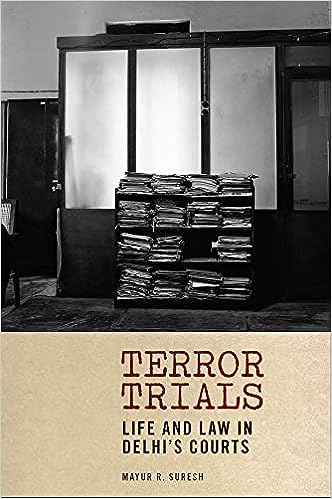
In Terror Trials: Life and Law in Delhi’s Courts, Mayur Suresh, through on-field encounters with terror trials in Delhi courts, brings out the intimate relationship between the law, police, and those in conflict with the law. Through documentation and paper bureaucracy, Suresh demonstrates the transformed relationship between the terror accused and the court.
To that extent, firstly, the author of this research paper seeks to provide a critical analysis of the book focusing on the use of documentation as a tool of violence and secondly, the state apparatus’s close alliance with the terror accused.
‘State of Exception’ – Myth or Reality?
Suresh criticizes the ‘state of exception’ as postulated by Agamben. Agamben’s state of exception is the opening of a space where the norm of the law becomes distinct from its application (Agamben, p. 1). The state of events is such that there is a temporary suspension of the rule of law. It is distinct from anarchy and chaos as an order still exists for the law to get realized. Suresh here opposes Agamben’s thesis of the ‘state of exception’ because it is implicit in the working of the modern-day State due to its coercive nature. Rather, Suresh argues that such anti-terror laws specifically make a classification and apply the same laws differently in different circumstances (p. 43). They are not exceptional for causing a deviation from democratic and constitutional principles. They are exceptional, as they tend to produce a new kind of jurisprudence for terror accused which is distinct from the normal course of action. To this effect, Suresh here points out, and that too brilliantly, that this ‘state of exception’ fails to account for how the terror accused responded to the changed situation by adapting themselves. The terror accused adapts himself through the means of documentation and understanding the language of the law.
‘Kagazi Raj’ (Paper Bureaucracy)
In Chapter 4, Suresh documents the use/ misuse of documentation in the lives of the terror accused. Suresh uses the term ‘hypertext’ to describe and emphasize the obsession of police with paperwork and files (p. 173). He points out that the inherent defect of excessive paperwork is to fabricate and create new realities which are, in fact, contrary to the actuality of events. Suresh, here, uses the case of Masoooda Parveen v. Union of India, wherein Regoo was murdered in the backdrop of the Kashmiri struggle for independence (p. 175). In this case, the police, army, and petitioner, all three, had distinct accounts of the events that occurred surrounding the death of Regoo. Suresh argues that documentation not only serves as an account of any event but becomes a tool to trust the source. Hence, the ability to furnish documentation backing your claim thus becomes imperative to ensure that juridical truth is produced (p. 171). This essentially shifts an arbitrary burden of proof against the terror accused to produce accurate documentation through the use of legal language.
Thus, in this mesh of paper and documents, Suresh draws an interesting parallel with ‘paper raj’ postulated by Nayanika Mathur. The production of paperwork is premised on the assumption that the government will produce accurate versions of reality (Mathur, 94). Mathur uses the example of NREGA scheme wherein transparency led to increased use of paperwork for registration, accounting, and proof of identification required to avail of the schemes. One needed to be adept in legal language to navigate one’s way through law and produce their account of truth. This leads us to the second aspect of the Book which is recycled legality.
Recycled Legality – Exception to ‘State of Exception’
In Chapter 2, Suresh introduces this concept of ‘recycled legality’ to highlight the intermingling of state, law, and violence (p. 138). Suresh argues that one could produce legal meaning by becoming an active participant in the trial process. Thus, interpretation of the law using legal language enabled the terror accused to create and inhabit the law oneself (p. 120). Suresh uses the example of Qayoom who is falsely accused of carrying out terrorist activities. Qayoom’s only way to build a strong defense against the State was by knowing the rules which governed the police during terror prosecution cases. Qayoom accomplished this by translating the rules into a language legible to him through a step-by-step granular process. Thus, the legal language which inherently is violent for controlling and surveilling the population was used for maneuvering within it to inhabit and carve out one’s space.
The second aspect of recycled legality points towards the inherent vulnerability of legal language. The vulnerability gets manifested when the legal language is used to bind the coercive power wielders – in this case police and prosecution – to the letter of the law. This occurs when the state’s inability to follow its own rules or do something ‘gair kanuni’ (illegal) is used to bind itself to its words and hold it accountable rather than moving away from the force of law. This brings out the paradox between legal language as having the dual capability of being coercive against citizens and vulnerable when citizens use it vis-à-vis the State. This ability to acquire the power to bind the State to its words is achieved by learning the language of the law and becoming inhabitants of the legal space.
This perfectly brings out the way a ‘state of exception’ can be brought within the democratic scheme of things through an interaction between terror trials and the law.
‘Custodial intimacy’ – A Paradox
Following the maneuvering with law, Suresh brings out a significant and intimate tension, distance, and closeness that develops between the terror accused and the police administration. Suresh describes the story of Shahid and provides a perfect example for this illustration. Shahid, a terror accused, and Dharamveer, the police officer prosecuting the case, develop an intimacy that ranges from sharing the loss of loved ones to developing an elder father-son bond between the two. However, Suresh is quick to point out the inherent violence underpinning this intimacy. Suresh argues that the development of this intimacy is premised on the opaqueness of the police and legal system towards the terror accused. This opaqueness creates uncertainty about the terror accused’s conviction or acquittal. This opaqueness is the product of latent violence ensuing from the intimacy between police officers and prison inmates. Suresh here beautifully brings out the human aspect of the relationship between the police and the terror accused which collides with their respective personal lives. Thus, a complex relationship emerges which is guided by both intimacy and intimidation.
Suresh then ends the book on a positive note corresponding to the end of a trial, i.e., acquittal. He shows that even minor technicalities that form the grounds of acquittal can cost the life of a terror trial. But he is mindful of the impact of the trial after the acquittal as the newfound freedom soon turns into a curse due to the fear of being suspected and arrested again.
Weaknesses of the book
The biggest achievement of Suresh’s book is that it makes a departure from the mundane courtroom trials and shows that it has a life of its own through the uniqueness of legal language. By documenting the real-life event at various stages of a trial proceeding and giving an honest perspective into the challenges of the terror accused navigating a trial, Suresh successfully departs from the mundane rules and regulations of the law and makes space for the human voice in the law (p. 283). He carefully shows that the courtroom inhabits a distinct space among the various State machinery. However Suresh fails to account for the social and political circumstances that inform this courtroom interaction between the prisoners and the police administration. We do not see the caste or religious identity of the prisoner or the police administration which navigates and modifies the interaction between the two.
On the other hand, Pratiksha Baxi’s book, Rape Trials actively engages with the question of the socio-cultural and economic backgrounds of the rape victim which features majorly in the prosecution’s narrative. Such an inquiry is lacking in Suresh’s work (Baxi, 14). Though he acknowledges the misuse of UAPA provisions against the Muslims and the Dalits, Suresh fails to elaborate on the experiences along those axes. But overall, this book is a successful attempt to bring forth the human aspect of the law and adds to the existing literature around terror trials.
References
Agamben, Giorgio. State of Exception, Kevin Atnell (trans.). University of Chicago Press, 2013.
Mathur, Nayanika. Paper Tiger: Law, Bureaucracy and the Developmental State in Himalayan India. Cambridge University Press, 2015.
Bio:
Aditi Ajay Pophare studies at National Law School of India University, Bangalore.
***
Like Cafe Dissensus on Facebook. Follow Cafe Dissensus on Twitter.
Cafe Dissensus Everyday is the blog of Cafe Dissensus magazine, born in New York City and currently based in India. All materials on the site are protected under Creative Commons License.
***
Read the latest issue of Cafe Dissensus Magazine, “(Re)storying Indian Handloom Saree Culture”, edited by Anindita Chatterjee, Durgapur Govt. College, West Bengal, India.
 Cafe Dissensus Everyday