
By Priyanshi Kothari
Introduction
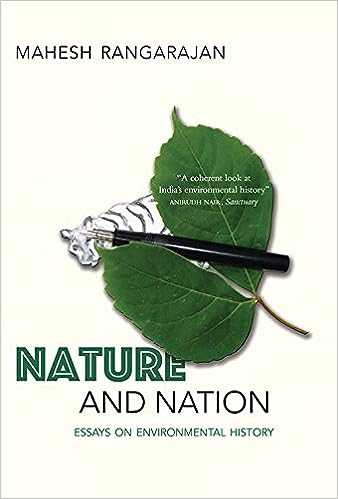
Mahesh Rangarajan’s Nature and Nation is a multidisciplinary inquiry dealing with the various strands of nation-building and its effect on ecology. This book is a collection of ten essays written between 1998 to 2012 (p. 2). The chapters are divided into three parts – nature’s past, present and future. It aims to comprehensively analyse the intersection of forestry, irrigation and carnivore control with politics, society and culture.[1]
Environmental historiography in India is a contested and niche area with limited available literature. The existing literature can be broadly classified into two major themes.[2] First, relates to the broad changes brought by the colonial policies impacting the environment.[3] Second, deals with the shift from indigenous water technologies to colonial water engineering.[4] Interestingly, this book falls outside these cliché environmental histories which solely focus on the colonial upheaval. Rangarajan differs from the existing literature by mapping the changes in environmental history on a longer framework. This strain of Rangarajan’s thought is better developed in another piece in which he explains that the earlier environmental history was written by the nationalist school to expedite colonial infamy.[5] Hence, when viewed from the Change and Continuity debate, Rangarajan falls among continuity scholars. This idea is complicated by the dialectical debates of modernisation and tradition and development and nature. Another interesting aspect is the impact of the conservationist policies on humans, especially the subaltern class which are dependent on nature for their livelihood and lives.
Before Nature and Nation, Guha and Gadgil’s The Fissured Land was one of the few books to have taken a comprehensive field of study.[6] However, in many aspects, both books make opposing arguments. Hence, it can be safely argued that the book Nature and Nation is one of the first books to undertake exhaustive research on the various environmental interactions in this discourse.
Rangarajan’s narrative
Through its ten essays, Nature and Nation provides a historical evolution of the policies impacting nature. Beginning with the pre-colonial, colonial and then post-colonial epochs, the author elucidates the shifts between development and nature based on the ideology of the state.
Rangarajan believes that the environmental discourse has erroneously been divided into pre-colonial and colonial times (p. 13). He rebuts the argument by Guha and Gadgil, who claimed that colonial administrators destroyed the long environmental homeostasis in the pre-colonial era.[7] Breaking this myth of a colonial watershed moment due to the oppressive policies of the colonial administrators, Rangarajan believes that environmental history can be better understood in a longer framework of time. This would prevent considering the pre-colonial time as a mere backdrop and would prove that environmental degradation and its adverse consequences existed even in the pre-colonial era (p. 14, 47). Any period in historiography should not be seen in isolation but by the varied ways of human mediation and interaction.[8]
Regardless, the pre-colonial era had mutually contradictory strands which were hard to reconcile. The myth of peaceful co-existence between humans and animals was broken as the same animal was simultaneously revered and feared, hunted and worshipped (p. 49).
After independence, the debates around development and human interference lie at the heart of the book. Various eminent politicians and scholars have expressed contradicting views on the desired future course of action. Without expounding on the imperial policies, Rangarajan moves on to explain the first debate that emerged on India’s developmental policy. In this debate, Mahatma Gandhi’s village economy conflicted with Jawaharlal Nehru’s conception of development and modernity (p. 143, 191). Being the Prime Minister of the country, Nehru was successful in implementing his ideology across the country. In the larger scheme of Nehru’s romanticisation of technology through dam construction, agrarian extension and industrialisation, forest cultures played a minor role (p. 201).
By the time his daughter Indira Gandhi came to power, the debate was narrowed down to the balance between the conflicting interests of humans and nature as development was considered a necessity (p. 180). Through ecological patriotism, Gandhi successfully protected animals, some of whom were on the verge of extermination (p. 166). She was the first person to protect animals not for the interests of the bourgeoisie but for the animals’ sake (p. 173). However, in this urge for environmental nationalism, she failed to recognise the rights of the subaltern population.
It is after setting this context that the author in the last chapter proceeds to argue the need to rethink the various questions dealing with nation and nature through an alternative approach. The strict separation between nature and humans through the formation of reserves isn’t successful in preventing the degradation of nature and the extermination of animals (p. 333). There is no guarantee that either the animals or humans would stick to these boundaries because of the continuous interaction between the species (p. 341). Rather, this makes it essential to understand the politics of ecology through the co-existence of humans and nature rather than studying them in isolation.
On methodological implications of the book, Rangarajan has done a comprehensive literature review before presenting his argument. To buttress his points, he has relied on secondary sources. This is appreciative on his part as he effectively engages with the current literature before adding a feather to it.
Interplay between nature and nation
Before delving into the themes of the book, it is important to elaborate on the title to concomitantly understand the impact of nation-building on nature. This intersection can be understood in two ways.
First, to understand the ramifications on nature through the decisions taken by politicians who have different inclinations. It is these political leaders’ nationalistic ideologies that have shaped nature in its current form. A comprehensive reading of all the chapters highlights this theme from the book.
Second, and a more interesting way to view the title is to contrast between the essentials of nature and the nation. Nation in its sovereign sense has fixed geopolitical boundaries. These boundaries show rigidity and control over the land and its people. For a long time, the conservation of nature was done by implementing the policy of reserves. Rangarajan propagates an alternative approach of having fixed borders for nature (p. 343). Micheal Mann has also argued that nature is an ideologically and socially constructed fluid category.[9] Consequently, this would prevent the strict demarcation of nature within those limited reserves to provide space for its repair and renewal with involves human interaction (p. 344). Hence, it is fascinating that the idea of nature and nation can be viewed both in dissonance and consonance with each other.
Development vs. nature
Environmental discourse deals with various questions that do not have teleological answers. These involve who should protect – state, private organisations or laissez-faire; what should be protected – humans or animals, and whether nature should be side-lined to pave the way for development. Considering these questions, I have picked two major themes that structure these debates in the larger framework and have been quite vibrantly expressed in the book. The first deals with the debate on development and its impact on nature. The second theme deals with the impact of humans and especially the subaltern interaction with the environment.
After independence, the notion of development was first conceived in the Nehruvian ideology. The policies like agrarian expansion and dam construction had adverse ramifications on humans and animals alike. While some critics might outrightly reject the Nehruvian ideology for being anti-nature, it is important to understand this phase by placing it in context to the changes happening during his time. After the drain of wealth by the Britishers, India was socially, communally and economically at its lowest phase. The only way to overpower the problems was by ensuring economic stability through developmental policies that would generate employment and growth. Moreover, while Nehru focussed on development, he still was interested in the prevention of the extermination of animals in Junagarh, the reserve for Asia’s last lions (p. 199). Similarly, when Indira Gandhi initiated Project Tiger or the Conservation Act, it is important to keep in mind that if not for her interference, there would have been the extermination of tigers (p. 166, 167). Hence, it isn’t fair to look at various leaders or politicians as mere extremists without looking at their policies and actions in their entirety. Rangarajan did a splendid job of explaining the ideologies of various conservationists or leaders through the course of their childhood and other important events of their life. Hence, Rangarajan is successful in showing the development-nature debate through a spectrum rather than the two opposites.
Man vs. Wild
The second debate that needs special emphasis is the interaction of humans and animals. This debate is more complicated and cannot be presented in a linear fashion through a Neo-Malthusian argument.[10] Through this book, Rangarajan has complicated this intersection to account for other needs and changes.
Among humans, different people have differential impacts based on their connection with nature. In this, the subaltern studies have always gotten special emphasis in environmental literature because the livelihoods of the subaltern people are directly dependent on forest produce and resources. However, in practice, the livelihood of the subaltern has continued to be snatched for centuries to make place for the industrialists’ profits. Unlike other environmental historians, who base their entire thesis on understanding subaltern studies, Rangarajan hasn’t devoted a separate chapter to it. Rather, he has explained the impact on them through evolutionary politics developed at various stages of the book.
Indira Gandhi, considered a pioneer in conservation, failed to take into account the concerns of the subaltern while framing her conservationist policies (p. 173). While she prevented the construction of developmental structures that would degrade nature, her response to subaltern livelihood was brutal. For instance, as one of the sites was being declared a national park, the Adivasis living around had overnight deprivation of grazing access leading to eviction of villagers without providing an alternate livelihood or place of living (p. 174).
Only over the subsequent years, as the dominant preservation methods were in crisis, various groups emerged and some of which focussed on the need for the protection of livelihood along with the conservation of nature. While what would be an adequate balance between the two might still be a question worth pondering, it must be seen along with prevalent subaltern conditions, government policies and a market-based economy. As Rangarajan argues, the need is to pave the way towards sustainability over the equity of rural studies (p. 280).
Missing colonial links
While Rangarajan has largely been successful in presenting his argument through this book, I would like to deal with two critiques of the book. First, deals with the addition of the colonial discourse on environmentalism and second, the changes in the structure of the book. The addition of these constructive changes would have made it a richer account of environmental history.
One of the major critiques of the book is that while the author does not believe in the distinction between the pre-colonial and colonial eras, he has failed to elaborate on the changes that were brought by the oppressive colonial regime. This is important because all the changes brought after the independence have a relationship with the colonial actions as British policies set the context on which the developmental policies are based. Authors like Sumit Sarkar who made a similar argument explained that the difference that emerged with the coming of colonial groups was their increased ability to enforce.[11] The Criminal Tribes Act, sedentarisation, agricultural expansion and technological advances led to Indian exploitation with no/ little native agency.[12] The addition of these accounts would have helped to solidify his argument by showing a similar policy of animal-human destruction prevailing even before the arrival of the Britishers.
For instance, the Britishers who considered their technological superiority as ‘modernity’, ignored ‘traditional’ forms of knowledge.[13] However, the shift to modern technology from the old systems has not always led to favourable consequences for nature as in the case of canals.[14] As a result, the future course of action taken by the subsequent leaders was in ideology taken to counter this adverse impact, but in practice, they blindly followed the British developmental strategies. Hence, the addition of the colonial policy would have been helpful to create a comprehensive picture by connecting nature’s past, present and future as the ecological footprint of colonial policies prevailed even after the Britishers left the country.[15]
Another critique that is worth mentioning is the lack of consistency between various chapters. It is understandable that this structural fault comes from the fact that the book was written as separate essays published by the author at different points in time. However, in a book, the various chapters must connect to ensure the structural flow of the book. For instance, the shift from the Nehruvian policy to the five conservationists in chapter seven lacks adequate connection. After this, the author makes a comparison of the Indian and African policies without giving adequate reasons for choosing Africa and the need for such a comparison.
However, despite these limitations, Rangarajan has been successful in exploring a niche area that has not been fully developed by the existing literature on environmental studies. The book would be useful for readers who wish to understand the intersection of history, nation-building and the environment, along with the various dualisms that existed in the discourse.
[1] Mahesh Rangarajan, ‘Environmental Histories of South Asia: A review essay’, White Horse Press 2(2) 1996 pp. 130.
[2] Michael Mann, ‘Environmental History and Historiography on South Asia: Context and Recent Publications’, South Asia Chronicle 2013 pp. 327.
[3] ibid.
[4] ibid, pp. 328.
[5] Mahesh Rangarajan, ‘Polity, ecology and landscape: new writings on South Asia’s past’, Studies in History 18(1) 2002 pp. 135.
[6] Ramchandra Guha and Madhav Gadgil, This Fissured Land: An Ecological History of India Oxford India Perennials, 1993.
[7] Guha and Gadgil, This Fissured Land: An Ecological History of India pp. 5-6.
[8] K Sivaramakrishnan, ‘Forests and Environmental History of Modern India’, Journal of Peasant Studies 36(2) 2013 pp. 300.
[9] Mann, ‘Environmental History and Historiography on South Asia: Context and Recent Publications’, pp. 324.
[10] Mann, ‘Environmental History and Historiography on South Asia: Context and Recent Publications’ pp. 325.
[11] Sumit Sarkar, Woods and Trees: The Environment and the Economy Modern Times: India 1880s-1950s Environment, Economy and Culture, Permanent Black pp. 82.
[12] ibid, pp. 77
[13] Lauren Minsky, ‘The British Empire and the Natural World: Environmental Encounters in South Asia by Deepak Kumar, Vinita Damodaran and Rohan D’Souza’, South Asian Environmental History, EPW 49(23) 2014 pp. 34.
[14] Rangarajan, ‘Environmental Histories of South Asia: A review essay’, pp. 136
[15] Minsky, ‘The British Empire and the Natural World: Environmental Encounters in South Asia by Deepak Kumar, Vinita Damodaran and Rohan D’Souza’, pp. 36
Bio:
Priyanshi Kothari is studies at National Law School of India University (NLSIU), Bengaluru, pursuing a B.A., LL.B. (Hons.) degree.
***
Like Cafe Dissensus on Facebook. Follow Cafe Dissensus on Twitter.
Cafe Dissensus Everyday is the blog of Cafe Dissensus magazine, born in New York City and currently based in India. All materials on the site are protected under Creative Commons License.
***
Read the latest issue of Cafe Dissensus Magazine, “(Re)storying Indian Handloom Saree Culture”, edited by Anindita Chatterjee, Durgapur Govt. College, West Bengal, India.
 Cafe Dissensus Everyday