
By Aadithya J Nair
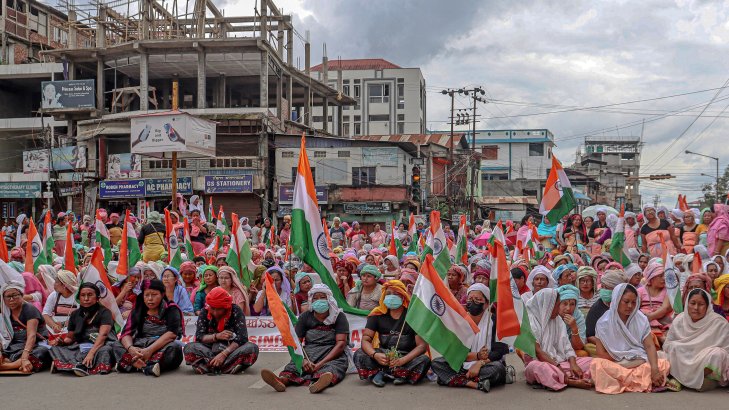
The viral video of the public shaming of a woman who was gangraped and then paraded around naked in the violence hit state of Manipur was outrageous and rightfully condemned by citizens in India and around the world. Condemning the incident, Chief Justice of India D.Y Chandrachud said, “Using women as an instrument in an area of communal strife to inflict gender violence is deeply disturbing. This is the grossest of constitutional abuse and human rights violations.”
Such deeply disturbing incidents are not completely shocking for they are a reflection of how problematic and inhuman a society could transform itself into if provoked by sectarian forces of violence and hatred. The issue, of course, is a reflection of the searing tension between the Kuki and Meitei communities in the state of Manipur. Yet, diversity has always been the fulcrum of the Indian society and therefore one wonders how close we as a nation are to trigger social explosions across the country in a similar manner.
The incident however saddening is a reflection of the complex dynamics in not just India but society at large across the world that needs to be understood to get to the root of the problem. This brings us to a very basic, yet pertinent question of what the foundation of the Indian society is.
Values and morals are often the common answer. After all, age-old norms of human conduct agreed upon by a majority of citizens form the basis of a society. There is also always a certain degree of diversity in every society – such as creed, race, caste and culture. But this diversity rarely dampens the spirit of togetherness and the society still functions through a consensus of opinions, upholding the spirit of ‘unity in diversity’. The Indian constitution in Article 1 says, “India, also known as Bharat, is a Union of States…”. India operates as a union of not just states but of differences as well.
However, the tragic incidents that have rocked Manipur in the last few months raise a disturbing question, i.e., does such a society always practice peaceful co-existence? The incidents weren’t just a knee-jerk reaction of the Kuki and Meitei communities due to their ethnic differences – the bomb has been ticking for a while as the seeds of divisionism were sown by sectarian forces driven by electoral politics.
The Gripping Truth
Whether peaceful coexistence is truly possible is a hard question. It is dependent on the social context and timeline we talk about. A society often has to face various riots and protests in the past. Disharmony and hate have always found a way into even the most relatively peaceful society. The current incident is bound to put the rainbow culture of the Indian society to a serious test amidst the ensuing violence, and the varied choices of citizens leading their lives have also been called into question in an autocratic quest by aggressive majoritarianism. A society needs to aspire to stray off these fault lines, because polarization can often be deepened into a dynamic dissolution of democracy.
The Presumption and the breakaway
So often, like most credible institutions, society in general is presumed to be peaceful in the beginning. By peace, of course, we don’t mean there is no strife at all. Anti-social elements exist that essentially form explosive associations based on a haphazardly framed ideology. Call them social time bombs (STBs), they act as agents of minor blasts that cause a scar but do not have the machinery or plan to go on a full-scale. In different societies, these STBs may take different forms and shapes, though their purpose remains same, i.e., to take control of socially volatile environment and cause discord.
A muti-dimensional society ideally allows the existence of people of different social backgrounds and faiths and emphasizes on adequate representation of all groups of people. Such a society creates laws and legislation catering to different needs of each group yet collectively operating in the spirit of basic human rights.
Such a society seems too good to be true, but the point is it never is. In an attempt to satisfy the needs of every individual, the society unintentionally cements clear differences among individuals. For example, by legislating a specific law to guard the interests of Muslims, the society creates a social divide as others see them as different.
Us vs Them Society
So, the ‘Us vs Them’ narrative slowly grows in the society and isn’t a result of any particular act of an individual or even state. Rather, it is the collective result of multiple factors that come into play. The division slowly begins to take roots as the culture of hate mongering begins to grow.
As discussed earlier, the birth of a society of hate is through an unintentional division of society by targeted legislations to alleviate the concerns of multiple diverse groups. Sooner or later, a divisive narrative strikes chord with the people and the ‘Us vs Them’ narrative takes shape exploited by social time bombs (STBs).
STBs become more lethal as they claim to represent a particular group and start to either create symbols of identity for these groups or amplify the existing symbols. STBs start to create the narrative of ‘Us vs Them’ quite quickly and efficiently, often using social media, public speeches, public gathering and mass-reach cultural discourses to consistently spread this message and systematically create an identity discourse of ‘Us vs Them.’
STBs would make a hue and cry about many legislations and give a spin to their narrative that everything done was anti-them and pro-other communities, thus creating ground for mass recruitment to their organization. Their narrative gains traction amongst citizens disillusioned with their lives who find a convenient dumping ground in the communal narrative manufactured by STBs.
The Political Step-up
STBs get legitimized once their political masters are on-board who create an issue, or issues, out of a non-issue such as ‘Us vs Them’, polarize communities and then turn poll outcomes in their favor. Political masters launch themselves into the arena after they test the waters of social volatility. Then they pick up the narrative, twist and turn it into their personal vote bank.
The political masters pump money into such narratives to breed the child of hate into a full-grown man spewing venom quite masterfully. Once polarization and communalism reach ridiculous levels, both the young and the old who were already on the edge of communalization are now officially integrated into the mass hysteria.
Every single medium of conversation and communication including social media, television, movies, books, music, festivals and social gatherings are targeted and people are on a daily basis fed loads of lies.
The lies pick up the heat on a mass of citizens raging into their consciousness who have now reached a point of no return and are hell bent on avenging the perceived injustices inflicted upon them by a particular community.
Reaping What is Sown
Equality and freedom of choice take a back seat as a new set of majoritarian laws are brought in by the political masters who set up a new regime that now pursues a policy of systematic hate mongering and who use new laws to infuriate and isolate minorities to the point of desolation.
Media is coerced to favor the incumbents and those who fail to fall in line are denounced traitors and are shamed, framed and blamed all the way to their grave.
All the actions of incumbents are colored with the national flavor, making them unquestionable. The minorities are no longer just miscreants but are now anti-nationals. The nationalist card gives the stamp of approval to hate-mongering and hate politics.
What happened in Manipur and in most other violence-hit regions is often derived from this method of madness foisted upon the Indian society. The diversity in the Manipuri community was misused by fringe elements to breed the hate culture that’s being seen today.
The Manipur clashes are not just a calamity but a clear writing on the wall of the things that can unfold in societies that house diverse communities if due attention is not paid to the anti-social narrative that is spread to the common people.
Bio:
Aadithya J Nair is a third-year law student pursuing Bachelor of Arts and Legislative Law at the National University of Advanced Legal Studies, Kochi, India. He is passionate about subjects such as law, history, political science, and economics. He won the Tata Gold Medal (Indian Based Company) in a school essay writing competition. He is into numerous legal welfare initiatives and is committed to the cause of social welfare.
***
Like Cafe Dissensus on Facebook. Follow Cafe Dissensus on Twitter.
Cafe Dissensus Everyday is the blog of Cafe Dissensus magazine, born in New York City and currently based in India. All materials on the site are protected under Creative Commons License.
***
Read the latest issue of Cafe Dissensus Magazine, “(Re)storying Indian Handloom Saree Culture”, edited by Anindita Chatterjee, Durgapur Govt. College, West Bengal, India.
 Cafe Dissensus Everyday