
By Vagmi Singh
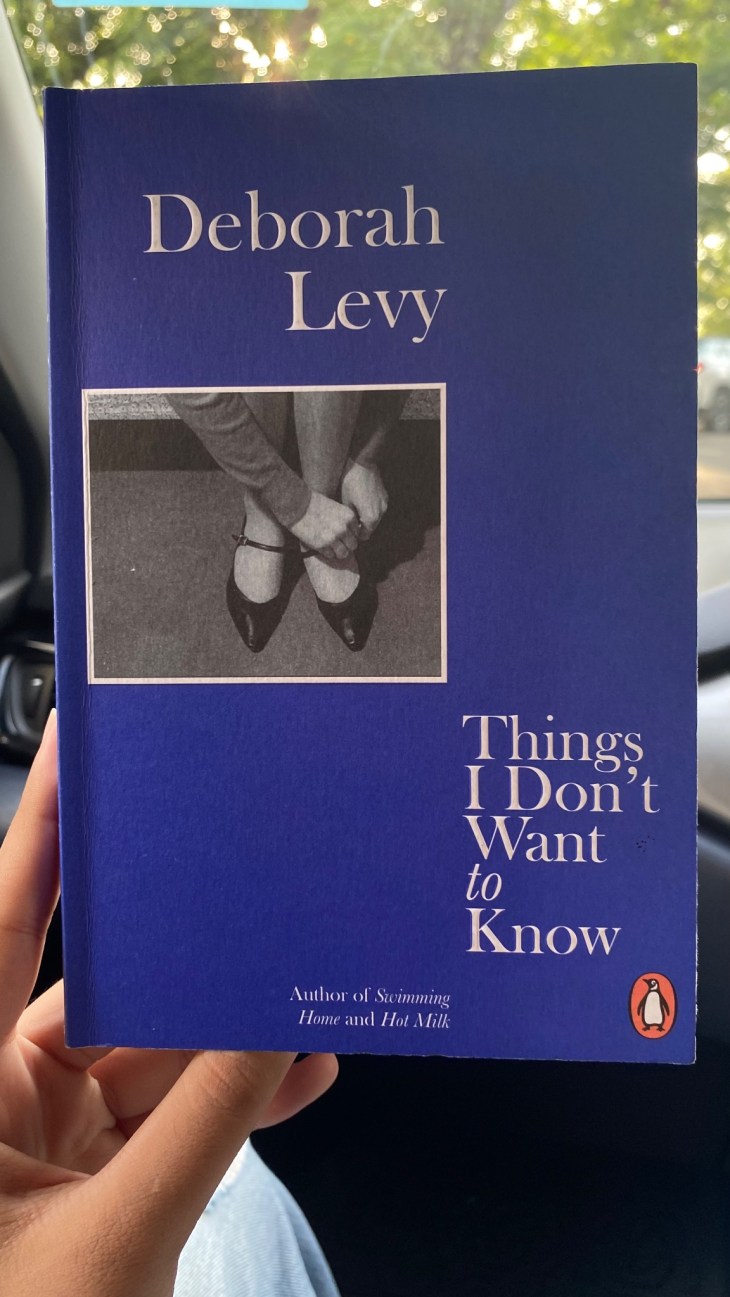
Deborah Levy’s Things I Don’t Want to Know was originally written as a reply to Why I Write by George Orwell. However, it turns into a memoir tracing her life experiences and setting the tone for two books that follow: The Cost of Living and Real Estate. As Deborah Levy observes, “To become a writer I had to learn to interrupt, to speak up, to speak a little louder, and then louder, and then to just speak in my own voice which is not loud at all.” She talks about finding her own voice in a world where women are perceived as immanent beings. Thus, the memoir becomes relatable and relevant to women across generations. Furthermore, she explains the complexities of her existence, shares the ‘partially orphaned childhood’ and tries to comprehend the social, economic and political oppression stemming from the apartheid regime. It speaks through the ages of oppression based on race, class and gender. To understand this intersectionality and examine the ‘political in the personal’, it becomes quintessential to contextually understand her journey.
Born in, then colonised, Johannesburg, South Africa, her father was a Lithuanian-Jewish migrant, while her mother belonged to an upper-class English colonial family. Her father, Norman Levy joined the African National Party and voraciously opposed the apartheid regime and soon found himself in prison. At that time, Levy was just five years old. She soon found herself being discriminated against under the regime. These external stressors, later, helped her explore identity, power dynamics and social justice in her writing. At the age of nine, she moved to England, a place conceptually considered to be more inclusive and tolerant towards diversity. However, the feeling of displacement coupled with racial, sexual and class-based discrimination led her to probe these themes deeply. Fame didn’t come to her early. She further shares her experiences of motherhood, divorce in old age and femininity. She notes, “Perhaps when Orwell described sheer egoism as a necessary quality for a writer, he was not thinking about the sheer egos of a female writer. Even the most arrogant female writer has to work overtime to build an ego that is robust enough to get her through January, never mind all the way to December.”
As Patricia Hill advocates, we need a new vision to analyse the oppression which is inclusive of race, class and gender. These new ways of thinking accompanied by actions offer a way to close the gap and foster new relationships across the spectrum and initiate social change. Furthermore, the book also highlights the sexual division of labour in domestic as well as non-domestic spheres. These divisions are not biological constraints but structural arrangements in our society as argued by Leith Mullings. The exclusion that Levy faced was based on the dichotomous conceptualisation of us and they which are further ranked in society.
This book review of Levy’s Things I Don’t Want to Know analyses and scrutinises the praxis of prejudice based on racial, sexual and class-based identity.
Things we need to know
The central focus of the book has been on gender. She examines her position as a woman in society and how her gender influences the way she perceives the world. Simone De Beauvoir in her seminal work, The Second Sex (1949), argues that one becomes a woman through cultural, social and psychological conditioning. Thus, it becomes evident that gender as distinct from sex is a social phenomenon as opposed to a natural precondition. Furthermore, Levy, in the first chapter, implicitly connects the role of the societal system and the pressure one gets from socially imposed expectations and defined roles as a woman. In Notes on Women, Work and Society, Leith Mullings validates this by pointing out the regional variation in gender composition in occupations across cultures. Furthermore, Bowitz argues that the sexual division of labour was pre-modelled on socio-economic considerations. This division caters to the social needs of society and is not necessarily based on equality. In the book, the author talks about Maria who neither married nor had children. Levy believes that Maria was wary of the rituals because she knew they would ultimately exploit her. Perhaps, to escape from the consequences of rejecting the socially imposed need, Maria lived away from her family, thereby highlighting the lack of choice women have when it comes to motherhood. However, fatherhood, perhaps male unconsciousness, often goes unscrutinised. Mostly Fatherhood, even in modern times, assumes a passive role in rearing children. Unfortunately, not much has changed.
Levy places discrimination based on sex at the backdrop of South African politics. At that time, the apartheid regime was dominant and racial oppression was on the rise. Tracing her history, she recognises the privilege of the whites. All the white children were studying in school while the black children were often mocked and at times mob lynched. This is primarily because white children were scared of black children. She recalls how the police once shot down black children, women and men. Segregated spaces and restriction on the movement of black people was common. On beaches, from the black community, only ice cream peddlers would be seen while white families enjoyed it. This stark differentiation moved her. After moving to England, she ate marmalade and kippers for breakfast, which seemed like the food of the king and queen of Ingerland.
This brings me to discuss the class divide that was and still is present in our society. Levy’s book is filled with instances which highlight class distinctions based on economic disparity, cultural segregation, educational divide, social exclusion and power dynamics. These cultural, ethnic, racial and gender-based discriminations are utilised in a way to support the system and maximise profits, as argued by Mullings. All these, indeed, helped the whites in South Africa to maximise their profits and colonise people. From observations at beaches to dining tables, Levy offers a rich repository of experiences recognising the complex intersectionality of race, gender and class.
Operationalising inclusivity
Sandra Harding conceptualised three dimensions of oppression. First is the institutional dimension. For instance, slavery as practised during colonial times was a profoundly patriarchal institution. Or for that matter, gender discrimination. They rest on white male supremacy, giving different levels of institutional protection to different cross-sectional identities. The second is the symbolic dimension. If we try to attribute adjectives based on gender, we cannot come up with universal images. For instance, white women were seen as the ideal wives, whereas African black women used to work in fields and were seen as physically powerful. These images significantly vary based on our cross-sectional identities. Third, individual dimensions. In Levy’s life, the cumulative effect of institutional treatment with symbolic meaning added to the multiple structures of oppression.
Nevertheless, these levels of oppression can be re-conceptualized and these barriers of class, gender and race can be bridged by building relationships and coalitions across the spectrum. Levy tries to do this using pen and paper. We can, perhaps, find our own ways to make an effort in the right direction. There are a few starting points from which we can begin. As Patricia Hill suggests, recognising the differences in power and privilege will help us to connect with each other. Each one of us is placed in a different position. Levy, perhaps, recognises the inability to fully grasp Maria’s situation as a black woman in the apartheid regime. However, this didn’t become an impediment to expressing her love for Maria. She resisted voyeurism in the process. Second, the common cause of fighting against exploitation and discrimination under the Apartheid regime united her father with blacks. Even if it meant going to prison, her father didn’t back out. This kind of solidarity against all forms of exclusion helps in the process. Third, building empathy and understanding different stances comes from individual responsibility. The privileged need to recognise their privilege like Levy and the oppressed abandon the basic assumption of mistrust for the powerful.
Packed with engaging writing, Things I Don’t Want to Know, a living autobiography, offers powerful insights into the complexities of identity, power struggle and social justice. It initiates a conversation on how differences in race, class, ethnicity and gender shape our personal experiences which are often shared across people belonging to similar spectrums. These identities actively determine our political, economic and social standing in society. Even if one tries to escape their influence, one can hardly succeed. In Carol Hanisch’s words, “Personal is political.” However, what we can do is strive for an inclusive and tolerant society as well as adopt new ways of thinking and acting by initiating a dialogue in our surroundings. The cliché of empathising and not sympathising still stands true. If practised, it can initiate a change. Perhaps, change for the betterment of the society. Understanding before categorising and judging is the key to this change. Each one of us has the key and all depends on who can muster the courage and apply the wisdom in the right direction. As Nelson Mandela quotes, “No one is born hating another person because of the colour of his skin, or his background, or his religion. People must learn to hate, and if they can learn to hate, they can be taught to love, for love comes more naturally to the human heart than its opposite.”
References
Beauvoir, Simone de. The Second Sex. Vintage Classics, 2015.
Collins, Patricia Hill. “Toward a New Vision: Race, Class, and Gender as Categories of Analysis and Connection.” Race, Sex & Class, vol. 1, no. 1, 1993, pp. 25–45.
Levy, D. (2018) Things I don’t want to know. UK: Penguin Random House.
Bio:
Vagmi Singh is an undergraduate student pursuing BA Sociology (Hons) at Hindu College, University of Delhi.
***
Like Cafe Dissensus on Facebook. Follow Cafe Dissensus on Twitter.
Cafe Dissensus Everyday is the blog of Cafe Dissensus magazine, born in New York City and currently based in India. All materials on the site are protected under Creative Commons License.
***
Read the latest issue of Cafe Dissensus Magazine, “(Re)storying Indian Handloom Saree Culture”, edited by Anindita Chatterjee, Durgapur Govt. College, West Bengal, India.
 Cafe Dissensus Everyday