
By Mursed Alam
“Dada, did anything change?
“I told you previously that nothing is going to change. People of Bengal do not like change. They gave the Left front more than thirty years; they will give TMC another thirty years.
How could there be change! Such use of violence!
“I would beg to differ. Only violence cannot win them so many seats. This means TMC is still holding the ground.
“I agree. And those who won with opposition tickets would eventually join TMC!
“You are right. But look at Naushad Siddiqui.
Yes, he has become a sort of national hero. Only thirty years old. And he will never join TMC. At least he will not sell himself.
“Let’s see. But we should change government every 5 years like in Kerala. But alas this is not going to be here.”
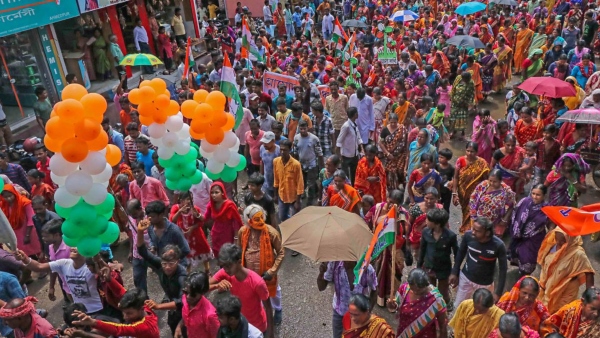
These snippets from the recently held Panchayat Elections in West Bengal perhaps capture the mood of the people of West Bengal. While political pundits can analyse better what this election means for Bengal politics, this short piece seeks to give some pointers based on the narratives that circulate in the public arena of Malda and on the author’s own experiences as a presiding officer during the Panchayat Elections. This piece is thus a mapping of the perceptions and discourses of the people gleaned from village tea shops, town libraries, college common rooms, etc., rather than a systematic study of the Panchayat Elections results backed by data, following sanctioned methodologies.
TMC & Poll Strategy
That the TMC still holds its ground is evident from the results and the vote share. How could TMC manage to do this despite allegations of rampant corruption, national agencies like CBI aggressively investigating cases of corruption against many TMC leaders and the media narrative dominated by such news? There can be many reasons. But it can hardly be denied that the social welfare schemes of Mamata Banerjee, whether we like it or not, proved to be a game changer. There might be cases of rigging, as those disgruntled with Mamata Banerjee’s rule say that this election is an example of ‘chappasree’ in a satirical reference to her social welfare schemes like Kanyashree, etc. But the schemes matter to the poor people. There is a fear among the ordinary people that if TMC is loses, there will be an uncertain future for these schemes. And TMC manipulated that fear quite well. They made it a point of their election campaign. There were miking heard in the villages: “Do you want Rs. 1000 per month or not? Just think about this before casting your vote.” We might criticise these populist measures. But their importance cannot be denied. Conversely, it is perhaps a sad commentary on our democratic system that for the poor people Rs. 1000 matters much more than questions of corruption and bad governance. As many people say, “No body would give us anything. Let them loot. At least we will get Rs. 1000 per month.”
Elections also need manpower, money and strategy to bring the voters to the polling station. As a presiding officer, I saw a strange thing which might give a clue to better understand this. As the polling day progressed, I witnessed that there were mostly female voters who were turning up to cast their votes and there were long queues of women voters outside. Compared to them, the male voters were very few in numbers. I later came to know that there were special autos and taxis and vans hired for the female voters so that they could come and cast their vote before returning to their domestic chores. The male voters would mostly flock the queues at around 5 PM when the slips are issued. Such clever voter management strategy to bring the voters to the polling station requires money and manpower which the TMC still monopolises in rural Bengal.
What is the source of this manpower for the party? Mr. Rana (name changed) said, “You see TMC has started a kind of contractor raj. All the contracts for the various developmental works would go to the party men. That means a lot of money, as there is huge corruption. Some of the money would flow back to the party as donation to the party fund.” If this perception is correct then there would be more people thronging around the party-hive, especially to the ruling party, for the benefits.
Of Violence, Religion and Caste
Much has already been written on the election violence. Nearly 50 people died (as per media reports). But one wonders why this much violence. Although there is a long history of political violence in Bengal, these days the panchayat bodies denote money and power. The amount of money pumped into the local panchayats for development works is unprecedented. A popular saying goes: “If you can become a Pradhan, once your five generation would live off the income.” Obviously, Panchayat Elections witness a lot of money, muscle power and use of violence.
Although it does not feature in the usual political commentary, it has become a common knowledge that the majority of the people involved in and dying in poll violence are Bengali Muslims. What is the reason behind this? As a respondent said, “You see the political parties do not field Bengali Muslims as MP and MLA but field them in the local elections. The reason is they live mostly in rural areas and they are useful foot soldiers for the election process during the Assembly and Lok Sabha elections and they need to feel involved. So, the Bengali Muslims who get this minimum chance of grabbing power at the local level steadfastly hold on to it and therefore feature prominently in the violence. There has been a criminalisation of the uneducated and unemployed Bengali Muslim youth during the TMC rule. Same is true for the lower castes. Have you seen any upper caste die during the elections? No. TMC is mostly a Banerjee and Banerjee Pvt Ltd.” If this perception holds any truth, this is going to persist in the near future.
Noushad Siddiqui & the ISF
This Panchayat Election proves that Naushad Siddique’s ISF is here to stay. Despite justified criticism of Abbas Siddiqui’s conservatism and vilification campaign by the TMC’s Kolkata based intellectuals, ISF seems to represent hope of a clean politics for many. Naushad, related to the Furfura Sharif, is polite, gentle, and truthful – something lacking in Bengal politics today. Perhaps the ruling party knows Naushad’s credentials. That’s why he was put behind bars, and allegations demeaning his character were floated before the elections. The popular sentiment goes: “O bikri hobe na” (He will not sell himself). Whether Siddiqui can capitalise on this trust of a section of the people, only time can say.
Who is the Opposition? BJP, Left, Congress?
Much to Suvendu Adhikari’s chagrin, the BJP vote share and influence continue to slide. Although the Left front and Congress could not raise their election tally higher, they perhaps would be emboldened that at least they are gaining back their lost ground. Can we see a Left-Congress gatbandhan in near future? Can that defeat TMC? That will depend on local and national matrix of politics and a constant work at the ground level.
I would like to end with an experience as a presiding officer at a polling station in Malda. The voters were mostly Adivasis and Scheduled Castes and apparently very poor. Many would not even properly understand how to cast the vote. But the enthusiasm was genuine. While taking their thump impression I saw that they were pressing their thumb unusually harder on the ballot paper. It felt strange to me at first. But soon I realised that they were somehow trying to assure themselves that their votes matter. That they matter. That democracy matters. And that no ruler can ignore them. Let us end with what we began: “But we should change government every 5 years like Kerala. But alas this is not going to happen here.”
Bio:
Mursed Alam teaches as Assistant Professor in the Department of English, Gour College, University of Gour Banga, India. His areas of research include subaltern studies, Islamic traditions in South Asia, literary and cultural history of Bengal Muslims etc. He was awarded the Charles Wallace India Trust fellowship in 2018 for archival work in the British Library. He is the managing editor of Kairos: A Journal of Critical Symposium and one of the founding members of Postcolonial Studies Association of the Global South (PSAGS). He has contributed articles and book reviews in journals such as Postcolonial Interventions: An Interdisciplinary Journal of Postcolonial Studies, Rethinking Marxism, Economic and Political Weekly, South Asia Research, Contemporary South Asia etc. He can be reached at mursedalam@gmail.com.
***
Like Cafe Dissensus on Facebook. Follow Cafe Dissensus on Twitter.
Cafe Dissensus Everyday is the blog of Cafe Dissensus magazine, born in New York City and currently based in India. All materials on the site are protected under Creative Commons License.
***
Read the latest issue of Cafe Dissensus Magazine, “(Re)storying Indian Handloom Saree Culture”, edited by Anindita Chatterjee, Durgapur Govt. College, West Bengal, India.
 Cafe Dissensus Everyday