
By Radhika Sabnis
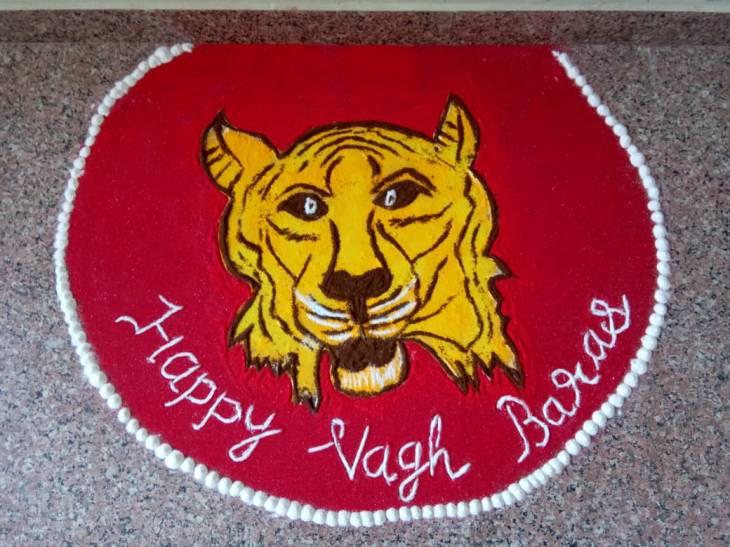
‘Vagh Baras’ is a festival celebrated predominantly among the Adivasi people of Thakur community in Raigad district of Maharashtra. Once a year, people from this community get together, go to a nearby waterbody, and build an idol of Lord ‘Vagh’ (tiger) out of mud and worship it. Everyone wears garlands and earrings made of bright orange and yellow marigold flowers, and a ceremony is conducted as people pray to Lord Vagh. In earlier times, it was believed that the purpose of this ritual was to please Lord Vagh and to seek protection for the cattle/livestock raised by people from any rogue animal attacks. Today, benevolence can’t be sought by prayer, as the rouge attacks are no longer on the cattle but the very way of life. The saffron beast charges with an all-consuming strength and ferocity.
The subject of Adivasi identity and culture has been at the center of a lot of debates and discourse. Various aspects of these subjects are understood through the ubiquitous theories of Sanskritisation/Brahminisation (given by MN Srinivas), which appear to have penetrated the realm of everyday conversations and common sense understanding. Defining Sanskritization in his book, Religion and society among the Coorgs of South India, Srinivas writes, “Sanskritization is a process by which a lower caste or tribe or any other group changes its customs, rituals, ideology and way of life in the direction of a higher or more often twice-born caste.” He further argues that Sanskritisation of a group usually has the effect of improving its position in the social hierarchy as it normally presupposes either an improvement in the economic or political position of the group concerned. This is a result of its contact with a source of the ‘Great Tradition’ of Hinduism.
These concepts are not stringently seen as academic jargon but are invariably considered to be universal truths or facts. These popular theories come from a single locus, perched atop, so that everything on the ground appears miniscule and insignificant.
In “Understanding Indian Society: The Relevance of Perspective from Below”, TK Oommen points out that these theories perpetuate a “cognitive blackout” in the field of social sciences, as they depict a one-dimensional picture of the reality. The so-called great tradition is always at the center, and everything is looked at and understood from this position at the center. In the Indian context, there is an assumption that the norms and values of caste Hindus are superior, standard, a template subjected to repeated and desirable replication. People from the lowest rungs of the social hierarchy do not think twice before abandoning their ways of life in favor of the so-called transcendental caste Hindu lifestyle. The Hindus automatically become the value givers and norm setters of society and every other culture is reduced to a mere attempt at imitation with the meek hope of gaining social mobility.
Festivals like ‘Vagh Baras’, which used to be popularly celebrated among the Adivasi communities of Thakur and Katkari (native to Karjat, Raigad district, Maharashtra) are now obscure; they are replaced by Ganesh Chaturthi, Diwali, and Navratri. Prima facie, this case appears to be the poster child of the phenomenon of Sanskritisation – “Little traditions” emulating the ways of a “Great tradition”. But this process of emulation is not as straight forward as it seems.
Nestled in the Western Ghats, Karjat is a scenic place full of hotels, resorts, and farmhouses, a lot of which are built on Adivasi residential areas. Stories of forceful evictions are common here. The Katkari community (one of the native Adivasi communities of Karjat) belongs to the particularly vulnerable tribal group. Majority of the people from this community lack legal ownership of land, and therefore, their main sources of livelihood include working at the brick kilns for at least one season (approximately 6 months) every year as bonded labourers, and working at the construction sites of farmhouses and resorts owned by people from nearby cities like Mumbai.
The Hindu landowners from Mumbai provide generous “donations” for the celebration of festivals like Diwali and Ganesh Chaturthi to the Adivasi people working on their construction sites. Along with this, people working as bonded labourers in brick kilns, usually receive remuneration and bonus payments around the time of major Hindu festivals. This implies the presence of direct monetary incentives for “Sanskritisation”.
Once this becomes a part of the cultural fabric, it is observed that the people belonging to Katkari community start taking huge debts from the brick kiln owners and money lenders for the celebration of these festivals. The money lending system works in a peculiar way in brick kilns. In the beginning, an agreement is made for the payment of Rs.600 for producing 1000 bricks at the brick kiln, but towards the time of final repayment of debt, Rs.400 is considered. Also, 1000 bricks are 1400-1500 in reality and Rs.400 is paid for that. Money is also given weekly to the working people, and it is usually half of their weekly wages.
So, what is agreed on in the beginning:
1000 bricks per day = Rs.600 per day
For 1 week, 7000 to 8000 bricks = Rs.4200 per week
½ of Rs.4200 = Rs.2100 (received for weekly expenditure)
This is nowhere close to the reality:
1400 to 1500 bricks per day = Rs.400 or less per day
For 1 week, 10,500 or more bricks = Rs.2800 per week
½ of Rs.2800 = Rs.1400 (received for weekly expenditure)
Manipulation of numbers is a norm, and this is how people get trapped in an infinite cycle of debt. There are several stories of people falling sick and being denied a day off and literally working themselves to death at the wretched kilns.
In reality, most of the working people ask for Rs.1000 as the amount received for weekly expenditure with the hope of paying back their debt at the earliest. A family of 4 to 5 people survives on Rs.1000 every week. There are cases of people getting one meal in four days. In rice fields, where rats take fallen grains of rice in their burrows, because of absence of a secure source of food, there have been instances where people had to dig into these burrows, get the grains of rice along with the rat and eat it. All of this, to fill the bellies of perpetually seeming hungry gods and goddesses of the big landlords, moneylenders and owners of the brick kilns.
Loans are also taken for conducting weddings. Big changes are observed in the marriage rituals among the Adivasi people. Originally, Katkari wedding ceremonies never included Brahmins or Bhattjis (priests) to chant prayers and ordain the couple. Now, there are no marriages without Brahmins who charge approximately Rs.15, 000 to Rs.20, 000 and demand for whatever the family produces – vegetables, grains, etc. Sometimes, weddings have two priests.
All of this makes one wonder about the aspect of social mobility associated with Sanskritisation. Where is it? Is it even logical to anticipate it? In the case of Katkari people, the so called Sanskritisation has left them destitute, and deprived, instead of granting them a higher position in the social hierarchy. The fact that any knowledge produced is tainted by the pre-existing conceptual categories of the knowledge producer is obvious. The awareness of one’s position in the social order and the impact it has on the formation of these conceptual categories is important. Either that, or the Hindu gods are biased.
Bio:
Radhika Sabnis has completed her BA in Social Sciences from Tata Institute of Social Science, Tuljapur, and MA in Philosophy from The Maharaja Sayaji Rao University, Vadodara.
***
Like Cafe Dissensus on Facebook. Follow Cafe Dissensus on Twitter.
Cafe Dissensus Everyday is the blog of Cafe Dissensus magazine, born in New York City and currently based in India. All materials on the site are protected under Creative Commons License.
***
Read the latest issue of Cafe Dissensus Magazine, “The Panorama of the Pandemic and the Female Subalternity”, edited by Silpi Maitra, Falakata College, West Bengal, India.
 Cafe Dissensus Everyday
Agree with your viewpoint! Generalization of perceived truths is a great folly in understanding the reality because perceptions are always biasied and secondly there are very few absolute(?) Truths.
LikeLike