
By Kabir Deb
Something that keeps on changing with time is the way literature is perceived. So, when we try to understand a writer of any magnitude, we must choose what we are trying to understand and how contemporary the artist is. It happens since a visionary of the past would only write about what we are going through in the present time.
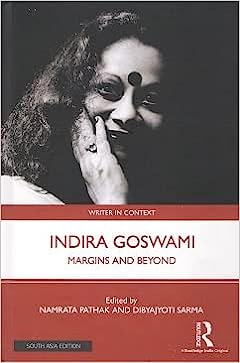
Therefore, a book like Indira Goswami: Margins and Beyond, edited by Namrata Pathak and Dibyajyoti Sarma, and published by Routledge, becomes so important to figure out the art of writing and how any writer has to reduce the gap of even a decade to be with everyone. Also, when we talk about margins and marginalised people, this book gives us an insight into how Indira Goswami goes beyond a single margin to write about people living in a thousand margins with an identity that matters to just a few.
This book is a collection of essays written by various writers on Indira Goswami’s novels, stories, and non-fiction writings, along with her ideology that stands apart from everyone.
A reader needs a guide to the mind of a writer to get into her world that has many infinities. This book works like Pessoa by Richard Zenith wherein we find a better picture of Fernando Pessoa’s life and philosophy.
With new regimes, and alteration of possibilities, Indira Goswami’s margins did not get neutralised since the oppression of the people living in the margin still remains the same. Through these essays, we find how Goswami literally weaved death, poverty, the manipulated definitions of sexuality and the constant oppression of women like a responsible storyteller. If we go through “The Unfinished Biography” by Indira Goswami and translated for this book by Dibyajyoti Sarma, we can understand how the writer made death a personal figure: an identifier of human haunting and downslide.
Regional writings are not talked about among the mainstream population as even literature always follows what is in the wind. But Goswami kept on scribbling about those who need her attention and a translator like Sarma with his book, Five Novellas About Women, kept her before us to push us to a place where marginality works as the momentum of the human psyche.
Indira Goswami: Margins and Beyond academically intersects with the fictional worlds of all those people we get to read about in Goswami’s stories. Most of the writers of these essays have clarity regarding the marriage between gender and state. So, almost all of them do not try to identify a person’s identity by dissociating him/her from the politics of the state. Although Goswami does not magnify politics more than a person’s crisis, the world of her characters and her ideology ignites the story of human existence. The reality of all her writings stays like it is without being a wonder.
The issue of class and caste played a major role in the becoming of Indira Goswami. So, in the non-fictional piece, “Burning” translated by Stuti Goswami and Jahnu Bharadwaj, we find the activist in the writer. Peace talks between the ruling government and United Liberation Front of Assam (ULFA) are a symptom of her desire. Her desire to not corner the oppressed people and to ask for their rights using proper diplomacy is the truth of a sound sociologist cum writer. To believe that all those people who have been dying in this civil war were our sons and daughters is a revelation of why Goswami is often referred as a “people’s writer.” For a writer, what works the most is the trust s/he shows towards his/her people and vice versa. Goswami had and received the trust she deserved. Therefore, her readers still feel the pain, and chaos around the throbbing optimism as their personal idea of knowing the nation and its various margins.
The patriarchy surrounding us is not limited to the borders of our society. It traverses some of the major peripheries of the human mind. Even when the issue spins around a different kind of oppression and discrimination, the entire weight falls upon a woman (both in reality and fiction). Indira Goswami kept on enlightening us about this simple concept that if we get to understand the condition of the state because of patriarchy, we will have many different answers regarding discrimination on the basis of class and caste.
“Sanskar”, translated by Anindita Kar, delivers us what patriarchy does when it gets the winter of other kinds of discrimination. Damayanti is a woman oppressed by the socio-economic condition of the state and so, her identity, practice and position are constantly questioned by men around her. The hypocritical norms of society always work against those women who start taking pride in who they are.
The magnification of reality becomes essential when people choose to stay blind deliberately and Goswami did that only. So, her fight for the labouring class with compassion and valour made the battle a personal one. Thus, Daisy Barman’s translation of Goswami’s piece on Harijan workers offers the readers a better idea of how their struggle against the capitalist society in our country stood useless.
Recently, I came across a dialogue in a web series named Farzi where the character played by Amol Palekar says, “The difference between rebellion and revolution is that rebels, at the end of the day, are identified as losers whereas revolutionaries bring change and are seen as winners.” After visiting the hunger strike of Harijan workers, Mamoni Raisom Goswami (the pen name of Indira Goswami) writes about how the capitalist economy smoothly destroys the rebellion of the workers who come from the economically weaker sections of society.
As the trajectory of Indira Goswami’s stories, letters and essays travels to all the corners of a sphere, this book is a compilation of perspectives by her readers.
For those who want to understand how a writer should penetrate the thick and insensitive skin of society, Indira Goswami: Margins and Beyond is a wonderful book to start with. It is almost impossible to harness and cultivate the magnanimity of a writer like Goswami as a reader and observer. But readers are meant to participate in the process of resurrection of a writer’s life. Dibyajyoti Sarma and Namrata Pathak compiled all these pieces to make this resurrection a reality.
Bio:
Kabir Deb is an author cum poet based in Karimganj, Assam. He works in Punjab National Bank and has completed his Masters in Life Sciences from Assam University and is presently pursuing his MCW from the University in Oxford. He is the recipient of Social Journalism Award, 2017; Reuel International Award for Best Upcoming poet, 2019; and Nissim International Award, 2021 for Excellence in Literature for his book, Irrfan: His Life, Philosophy and Shades. He runs a mental health library named ‘The Pandora’s Box to a Society called Happiness’ in Barak Valley.
***
Like Cafe Dissensus on Facebook. Follow Cafe Dissensus on Twitter.
Cafe Dissensus Everyday is the blog of Cafe Dissensus magazine, born in New York City and currently based in India. All materials on the site are protected under Creative Commons License.
***
Read the latest issue of Cafe Dissensus Magazine, “The Panorama of the Pandemic and the Female Subalternity”, edited by Silpi Maitra, Falakata College, West Bengal, India.
 Cafe Dissensus Everyday